
The Kiss at the Hôtel La Ville
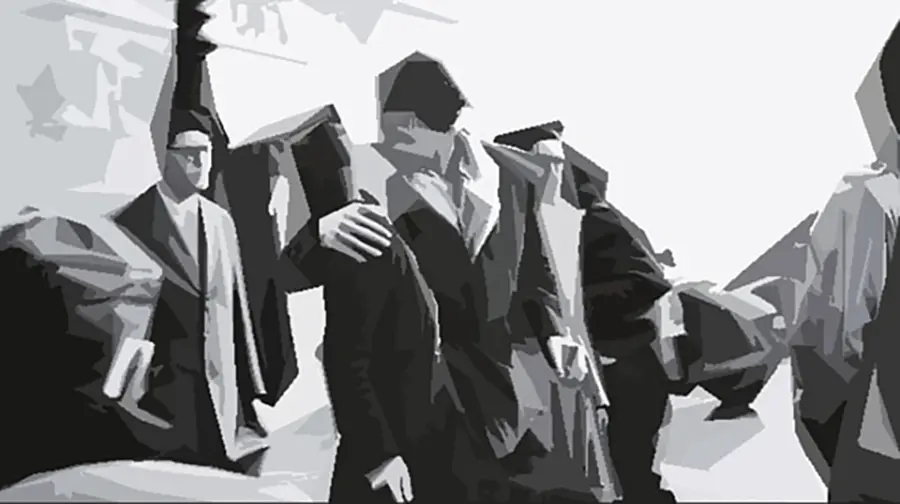
This work is anchored in one of the most reproduced photographs of the twentieth century. Originally square, the image was reclaimed in 1986 by an editor for an advertising campaign that popularized its horizontal aspect ratio.
As an icon deeply embedded in the collective subconscious, the image operated as a seemingly immutable visual object, fixed within the cultural memory. Subjecting this artifact to the mechanism of the Generative Gaze revealed an unexpected truth: the image was not nearly as stable as presumed.
By applying the principles of perceptual deconstruction and reconstruction, specific elements constituting the scene underwent radical morphological shifts. The automobile and the figures on the right—particularly the man at the periphery—transmuted into near-futuristic entities, characterized by geometric silhouettes and volumes that evoke a distinct science-fiction aesthetic. Yet, the core semantic meaning of the work—the kiss as the central gesture—remained intact and instantly recognizable, anchoring the composition firmly in its original emotional resonance.
This selective mutation demonstrates that cultural icons are not static monuments, but dynamic visual architectures harboring multiple latent realities. In deconstructing the image, its meaning is not erased; rather, the coexisting perceptual layers within it are laid bare.
The 1950 kiss and the futuristic figures coexist within the same spatial plane, proving that the Generative Gaze does not choose between past and future, but rather superimposes them into a single, expanded present.
Tamaño:
Paper 15.74" x 9.84"
Pictorial mass: 9.84" x 5.51"
Technique
Acrylic on paper.
The Kiss at the Hôtel La Ville
This work is anchored in one of the most reproduced photographs of the twentieth century. Originally square, the image was reclaimed in 1986 by an editor for an advertising campaign that popularized its horizontal aspect ratio.
As an icon deeply embedded in the collective subconscious, the image operated as a seemingly immutable visual object, fixed within the cultural memory. Subjecting this artifact to the mechanism of the Generative Gaze revealed an unexpected truth: the image was not nearly as stable as presumed.
By applying the principles of perceptual deconstruction and reconstruction, specific elements constituting the scene underwent radical morphological shifts. The automobile and the figures on the right—particularly the man at the periphery—transmuted into near-futuristic entities, characterized by geometric silhouettes and volumes that evoke a distinct science-fiction aesthetic. Yet, the core semantic meaning of the work—the kiss as the central gesture—remained intact and instantly recognizable, anchoring the composition firmly in its original emotional resonance.
This selective mutation demonstrates that cultural icons are not static monuments, but dynamic visual architectures harboring multiple latent realities. In deconstructing the image, its meaning is not erased; rather, the coexisting perceptual layers within it are laid bare.
The 1950 kiss and the futuristic figures coexist within the same spatial plane, proving that the Generative Gaze does not choose between past and future, but rather superimposes them into a single, expanded present.
Tamaño:
Paper 15.74" x 9.84"
Pictorial mass: 9.84" x 5.51"
Technique
Acrylic on paper.