
Tezcatlipoca and the Drinkers of Mezcal
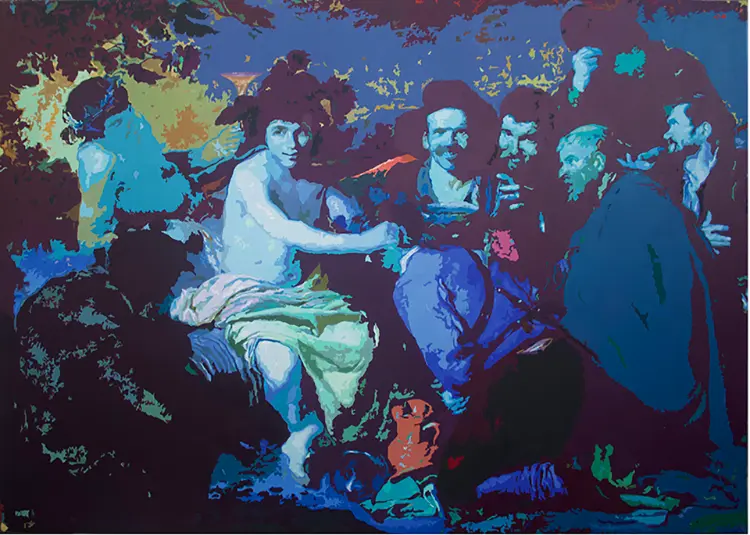
This work reinterprets Diego Velázquez’s The Triumph of Bacchus (1629, Museo del Prado) by initiating a transcultural dialogue: fusing the Roman god of wine with Tezcatlipoca, the supreme Aztec deity. This synthesis reveals that beneath disparate nomenclatures and geographies, both civilizations shared a fundamental ontological comprehension of the divine.
Bacchus embodies joy and ecstasy, yet equally personifies the madness and degradation wrought by wine. In parallel, Tezcatlipoca—manifested as Omácatl—was the patron of festivities and pulque; yet in other avatars, such as Itztlacoliuhqui, he presided over sin and destitution. Both deities encapsulate the exact same duality: the celestial and the destructive coexist within the singular act of intoxication.
Mezcal—a spirit exceeding 50% ABV with semi-hallucinogenic properties and roots tracing back to 400 BCE—supplants the Baroque wine. This is no mere substitution, but a profound declaration on the permanence of ritual: intoxication as both the portal to the sacred and the threshold of the abyss.
The piece perfectly exemplifies the Generative Gaze: dismantling a classical image to expose the invisible connective tissue between disparate cultures and epochs. What appears geographically and temporally distant—Rome and Tenochtitlan, Bacchus and Tezcatlipoca—is revealed, under the recalibrated gaze, as divergent expressions of a singular human condition.
Size:
60.62" x 44.09"
Technique:
Oil on canvas.
This work resides within a private collection in Alberta, Canada.
Tezcatlipoca and the Drinkers of Mezcal
This work reinterprets Diego Velázquez’s The Triumph of Bacchus (1629, Museo del Prado) by initiating a transcultural dialogue: fusing the Roman god of wine with Tezcatlipoca, the supreme Aztec deity. This synthesis reveals that beneath disparate nomenclatures and geographies, both civilizations shared a fundamental ontological comprehension of the divine.
Bacchus embodies joy and ecstasy, yet equally personifies the madness and degradation wrought by wine. In parallel, Tezcatlipoca—manifested as Omácatl—was the patron of festivities and pulque; yet in other avatars, such as Itztlacoliuhqui, he presided over sin and destitution. Both deities encapsulate the exact same duality: the celestial and the destructive coexist within the singular act of intoxication.
Mezcal—a spirit exceeding 50% ABV with semi-hallucinogenic properties and roots tracing back to 400 BCE—supplants the Baroque wine. This is no mere substitution, but a profound declaration on the permanence of ritual: intoxication as both the portal to the sacred and the threshold of the abyss.
The piece perfectly exemplifies the Generative Gaze: dismantling a classical image to expose the invisible connective tissue between disparate cultures and epochs. What appears geographically and temporally distant—Rome and Tenochtitlan, Bacchus and Tezcatlipoca—is revealed, under the recalibrated gaze, as divergent expressions of a singular human condition.
Size:
60.62" x 44.09"
Technique:
Oil on canvas.
This work resides within a private collection in Alberta, Canada.