
Song for Three Girls
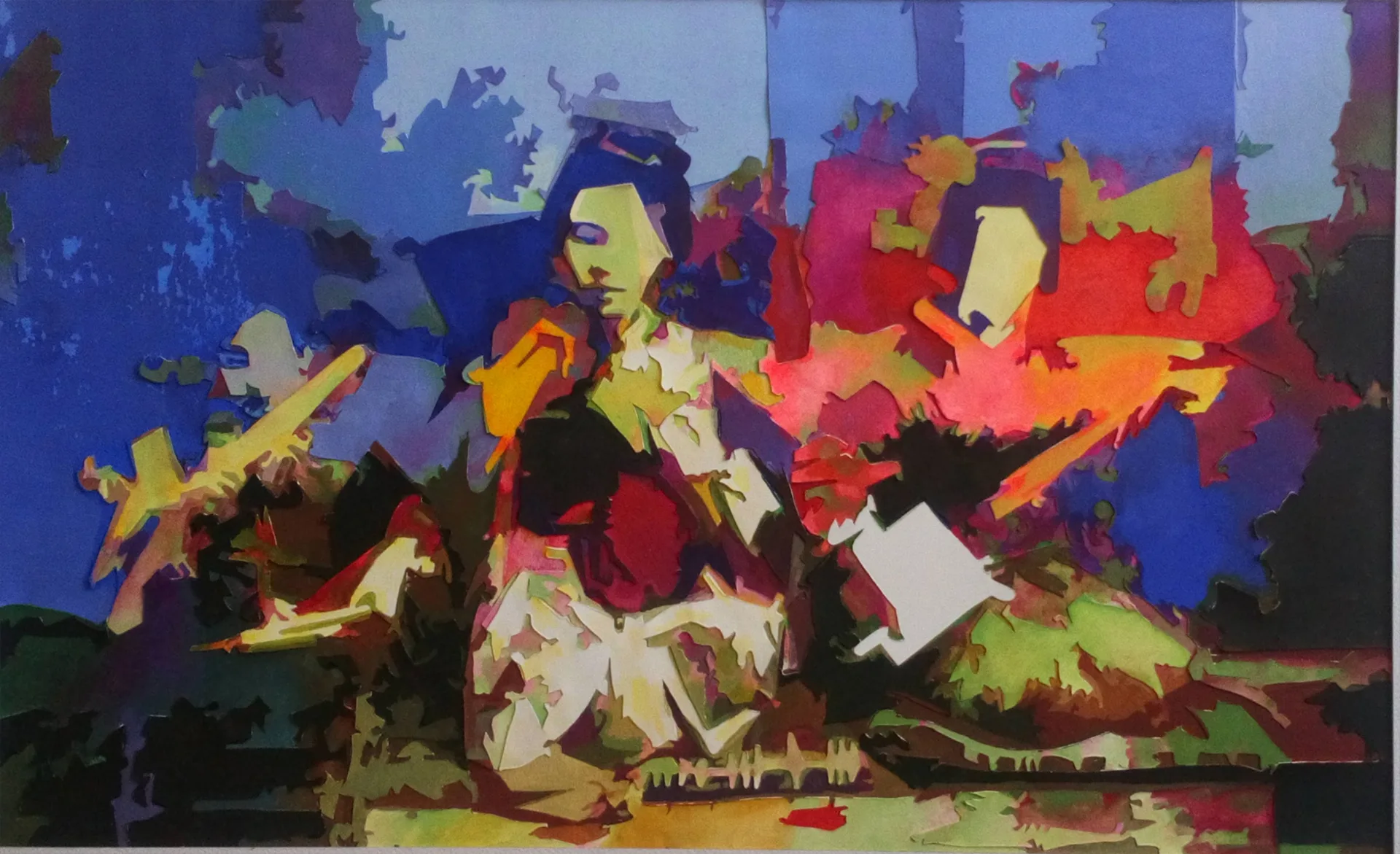
Anchored in a late Edo-period Japanese photograph, this work treats the original image strictly as perceptual raw material. The objective is not the replication of a historical scene, but rather the subjecting of it to a process of physical deconstruction, designed to lay bare the underlying mechanism by which the gaze constructs reality.
The technical methodology—delineating chromatic zones, excising them, painting, and adhering them—transforms the traditional pictorial act into an exercise in perceptual assembly. Each excised fragment operates as an autonomous unit which, upon recomposition, generates an emergent image. While this approach evokes Matisse’s cut-outs, it seeks not stylistic imitation, but the application of the same operational principle: visual reality is constructed through the deliberate selection, excision, and reorganization of previously isolated elements. The final image exists neither in the original photograph nor within the disparate fragments; it emerges solely when the viewer actively completes the act of cognitive recomposition.
The decision to manipulate acrylic to emulate the fluidity of watercolor—introducing gradients that disrupt the series’ dominant flat-color paradigm—marks a critical perceptual inflection point. This technical rupture is not driven by mere aesthetic pursuit, but by the necessity to stress-test whether the series’ core theories can withstand and integrate tonal complexity. The outcome confirms that the Generative Gaze is not tethered to a fixed visual lexicon; rather, it continuously actualizes itself through every decision that compels the eye to actively reconstruct its visual field.
Through the lens of the Generative Gaze, this piece demonstrates that the processes of creation and perception operate under an identical systemic logic: select, fragment, recompose. Ultimately, this work does not merely depict a scene from feudal Japan; it lays bare the very mechanism by which any image—whether ancient or contemporary—is transmuted into reality the moment a gaze structures it.
Size:
Paper: 27.55" x 19.68"
Pictorial Mass: 19.68" x 11.81"
Technique::
Acrylic on cut paper, mounted on support
Song for Three Girls
Anchored in a late Edo-period Japanese photograph, this work treats the original image strictly as perceptual raw material. The objective is not the replication of a historical scene, but rather the subjecting of it to a process of physical deconstruction, designed to lay bare the underlying mechanism by which the gaze constructs reality.
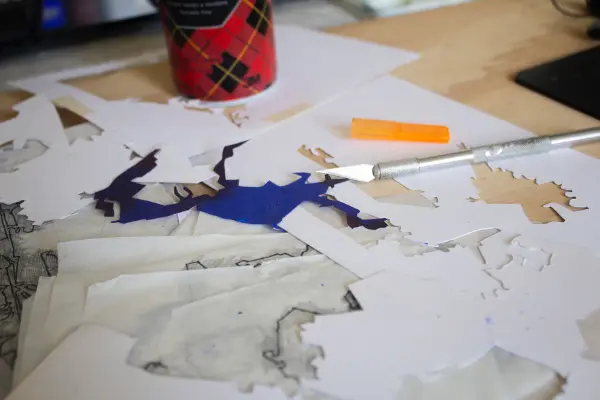
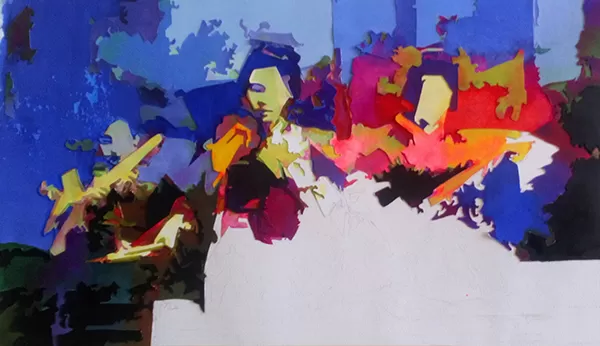
The technical methodology—delineating chromatic zones, excising them, painting, and adhering them—transforms the traditional pictorial act into an exercise in perceptual assembly. Each excised fragment operates as an autonomous unit which, upon recomposition, generates an emergent image. While this approach evokes Matisse’s cut-outs, it seeks not stylistic imitation, but the application of the same operational principle: visual reality is constructed through the deliberate selection, excision, and reorganization of previously isolated elements. The final image exists neither in the original photograph nor within the disparate fragments; it emerges solely when the viewer actively completes the act of cognitive recomposition.
The decision to manipulate acrylic to emulate the fluidity of watercolor—introducing gradients that disrupt the series’ dominant flat-color paradigm—marks a critical perceptual inflection point. This technical rupture is not driven by mere aesthetic pursuit, but by the necessity to stress-test whether the series’ core theories can withstand and integrate tonal complexity. The outcome confirms that the Generative Gaze is not tethered to a fixed visual lexicon; rather, it continuously actualizes itself through every decision that compels the eye to actively reconstruct its visual field.
Through the lens of the Generative Gaze, this piece demonstrates that the processes of creation and perception operate under an identical systemic logic: select, fragment, recompose. Ultimately, this work does not merely depict a scene from feudal Japan; it lays bare the very mechanism by which any image—whether ancient or contemporary—is transmuted into reality the moment a gaze structures it.
Size:
Paper: 27.55" x 19.68"
Pictorial Mass: 19.68" x 11.81"
Technique::
Acrylic on cut paper, mounted on support