
Musubi shiki
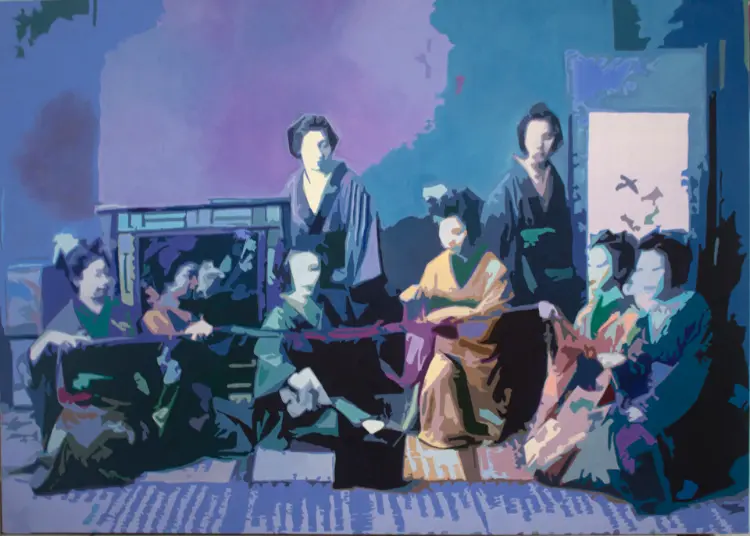
"Musubi shiki," roughly translated as "The Ceremony of the Bond," is anchored in a photograph from late Edo-period Japan.
The original image captures a pivotal historical transition—a world on the threshold of dissolution, yielding to the onset of modernity. This engagement with Eastern aesthetics establishes a direct conceptual bridge to contemporary visual sensibilities. The schematic draftsmanship and flat chromatic fields, inherited from both the classical Japanese masters and the graphic lexicon of sequential art and animation, operate here as the structural cipher to dismantle the original scene.
Eschewing Western mechanical rigidity, the work is constructed through an intuitive, kinetic dialogue with the surface. Although the Generative Gaze series implies a highly structured deconstruction, this piece retains the essence of an immediate, visceral engagement with the canvas. Here, the pictorial mass and flat color define the figures without reliance on a rigid preliminary underdrawing. The silhouettes of the women, resolved into modular blocks of color and crisp contours, do not pursue photographic fidelity, but rather the translation of a highly specific cultural atmosphere.
The conceptual knot bound by this work extends far beyond the physical ties uniting the figures in the depicted ceremony; it links the twilight of the Edo period with the present, Zen philosophy with sequential art, and intuition with structural logic. Much like the martial art of aikido, where an aggressor's kinetic force is redirected without frontal opposition, the original image is neither combated nor copied. Instead, it is deflected along a novel trajectory that conserves its inherent energy while fundamentally altering its vector. What endures is that precise, liminal instant when two distinct worlds intersect and, upon separating, catalyze an emergent reality that did not previously exist.
Size::
31.49" x 39.37"
Technique:
Oil on canvas.
Musubi shiki
"Musubi shiki," roughly translated as "The Ceremony of the Bond," is anchored in a photograph from late Edo-period Japan.
The original image captures a pivotal historical transition—a world on the threshold of dissolution, yielding to the onset of modernity. This engagement with Eastern aesthetics establishes a direct conceptual bridge to contemporary visual sensibilities. The schematic draftsmanship and flat chromatic fields, inherited from both the classical Japanese masters and the graphic lexicon of sequential art and animation, operate here as the structural cipher to dismantle the original scene.
Eschewing Western mechanical rigidity, the work is constructed through an intuitive, kinetic dialogue with the surface. Although the Generative Gaze series implies a highly structured deconstruction, this piece retains the essence of an immediate, visceral engagement with the canvas. Here, the pictorial mass and flat color define the figures without reliance on a rigid preliminary underdrawing. The silhouettes of the women, resolved into modular blocks of color and crisp contours, do not pursue photographic fidelity, but rather the translation of a highly specific cultural atmosphere.
The conceptual knot bound by this work extends far beyond the physical ties uniting the figures in the depicted ceremony; it links the twilight of the Edo period with the present, Zen philosophy with sequential art, and intuition with structural logic. Much like the martial art of aikido, where an aggressor's kinetic force is redirected without frontal opposition, the original image is neither combated nor copied. Instead, it is deflected along a novel trajectory that conserves its inherent energy while fundamentally altering its vector. What endures is that precise, liminal instant when two distinct worlds intersect and, upon separating, catalyze an emergent reality that did not previously exist.
Size::
31.49" x 39.37"
Technique:
Oil on canvas.