
Was ist los?
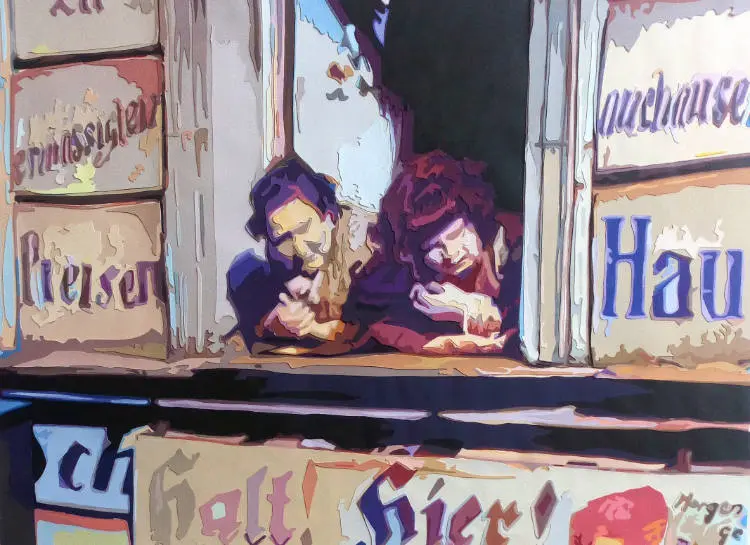
What is Happening?" (Was ist los?)
Was ist los? originates from a single frame of Walter Ruttmann’s seminal 1927 documentary Berlin: Symphony of a Metropolis.
The scene situates the viewer in interwar Germany: women perched on a balcony observe with a passive gaze a disruptive event unfolding in their environment. This posture constitutes the conceptual core of the work, functioning as an unflinching mirror to our own society, which frequently observes the violence, injustice, and abuse of power occurring around it with indifference and detachment. It serves as a dire warning regarding the perils of passivity, recalling how few in the Weimar Republic anticipated the looming catastrophe.
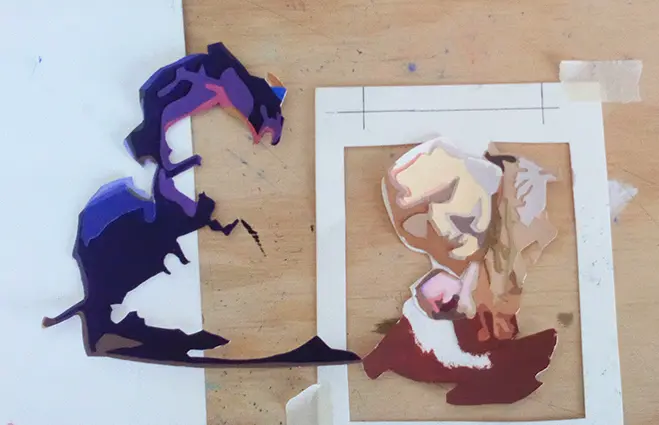
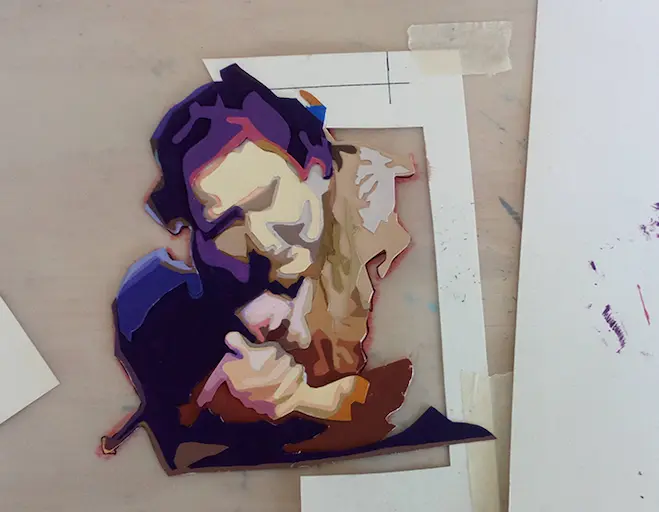
To actualize this inquiry, the work continues its exploration of collage through flat, pure colors applied to incised paper. The inherent topography of the material casts actual shadows across the surface, compelling the visual cortex to reconcile the painted luminosity with the physical shadows. This generates a profound perceptual friction—a cognitive dissonance—where the sensation of color and spatial depth fluctuates contingent upon the observer's physical vantage point.
Through this structural dialectic, the work establishes a powerful contrast: while the depicted figures maintain a passive gaze toward the unfolding of history, the material technique demands an active, engaged gaze from the viewer. Was ist los? thus crystallizes the ethical imperative of the Generative Gaze: it confronts us with the necessity to refuse the role of inert bystanders, compelling us to look actively in order to construct, interrogate, and synthesize meaning from the reality that surrounds us.
Size:
Paper: 27.55" x 19.68"
Pictorial Mass: 19.68" x 13.77"
Technique:
Acrylic on cut paper.
Was ist los?
What is Happening?" (Was ist los?)
Was ist los? originates from a single frame of Walter Ruttmann’s seminal 1927 documentary Berlin: Symphony of a Metropolis.
The scene situates the viewer in interwar Germany: women perched on a balcony observe with a passive gaze a disruptive event unfolding in their environment. This posture constitutes the conceptual core of the work, functioning as an unflinching mirror to our own society, which frequently observes the violence, injustice, and abuse of power occurring around it with indifference and detachment. It serves as a dire warning regarding the perils of passivity, recalling how few in the Weimar Republic anticipated the looming catastrophe.
To actualize this inquiry, the work continues its exploration of collage through flat, pure colors applied to incised paper. The inherent topography of the material casts actual shadows across the surface, compelling the visual cortex to reconcile the painted luminosity with the physical shadows. This generates a profound perceptual friction—a cognitive dissonance—where the sensation of color and spatial depth fluctuates contingent upon the observer's physical vantage point.
Through this structural dialectic, the work establishes a powerful contrast: while the depicted figures maintain a passive gaze toward the unfolding of history, the material technique demands an active, engaged gaze from the viewer. Was ist los? thus crystallizes the ethical imperative of the Generative Gaze: it confronts us with the necessity to refuse the role of inert bystanders, compelling us to look actively in order to construct, interrogate, and synthesize meaning from the reality that surrounds us.
Size:
Paper: 27.55" x 19.68"
Pictorial Mass: 19.68" x 13.77"
Technique:
Acrylic on cut paper.