
Tlalocan of Tepantitla
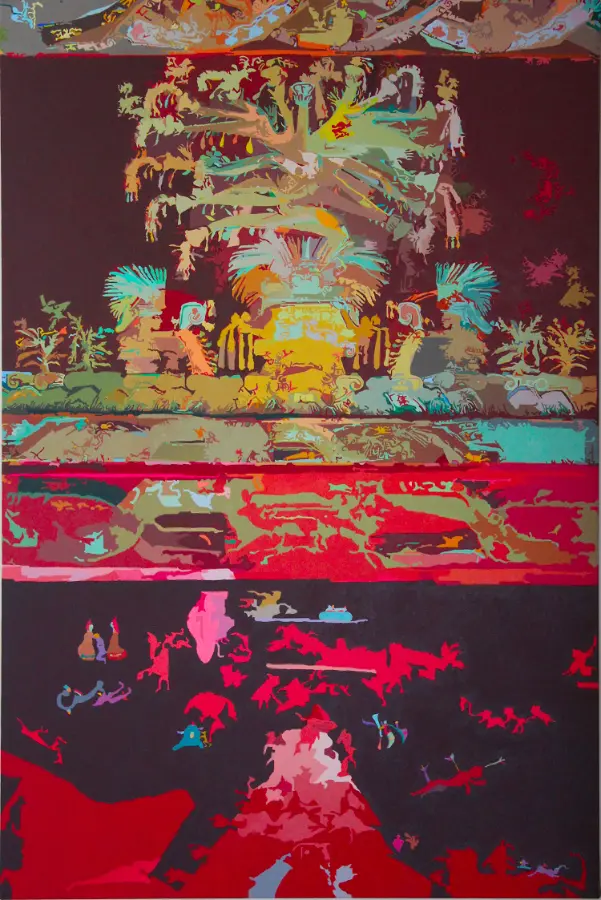
This work draws its genesis from the Tlalocan mural at Tepantitla, Teotihuacan, yet it functions neither as an archaeological record nor as a devotional reproduction.
Here, the Pre-Hispanic image operates as a perceptual matrix. Its original visual language—crisp linework, flat chromatic planes, and segmented composition—already functions as a code that deconstructs the illusion of depth to prioritize symbolic structure. The pictorial intervention does not append historical narrative; rather, it activates the visual grammar latent within the mural, exposing how an ancient civilization constructed its reality through the codified observation of nature.
The composition is organized into horizontal registers separating the celestial, the terrestrial, and the underworld, yet it entirely dismantles any traditional narrative hierarchy. Each zone is resolved through planes of pure color and defined contours that compel the eye to actively reconstruct spatial relationships. The palette vibrates between telluric reds, verdant greens, and aqueous blues, translating the Mesoamerican cosmogony not as a static myth, but as a dynamic system of perception in constant motion. The lateral figures and the central presence of the rain god do not represent fixed dogmas; they demonstrate the mechanism through which the observed is transmuted into meaning.
Through the lens of the Generative Gaze, this piece establishes that ancient and contemporary perception share the exact same operative principle: reality is actualized when a gaze structures it. The Teotihuacan mural already functioned under the axiom that to observe is to synthesize chaos into form. The contemporary iteration does not merely replicate that act; it renders it visible. By subjecting the image to a process of deconstruction and chromatic recomposition, the work exposes that no visual system captures an objective truth. All construct worlds through selection, excision, and the assignment of value to the observed. Tlalocan ceases to be a mythical paradise, transmuting instead into a field of perceptual operations where history, symbol, and gaze converge within a singular, generative act of creation.
Size:
35.43" x 47.24"
Technique::
Oil on canvas.
Tlalocan of Tepantitla
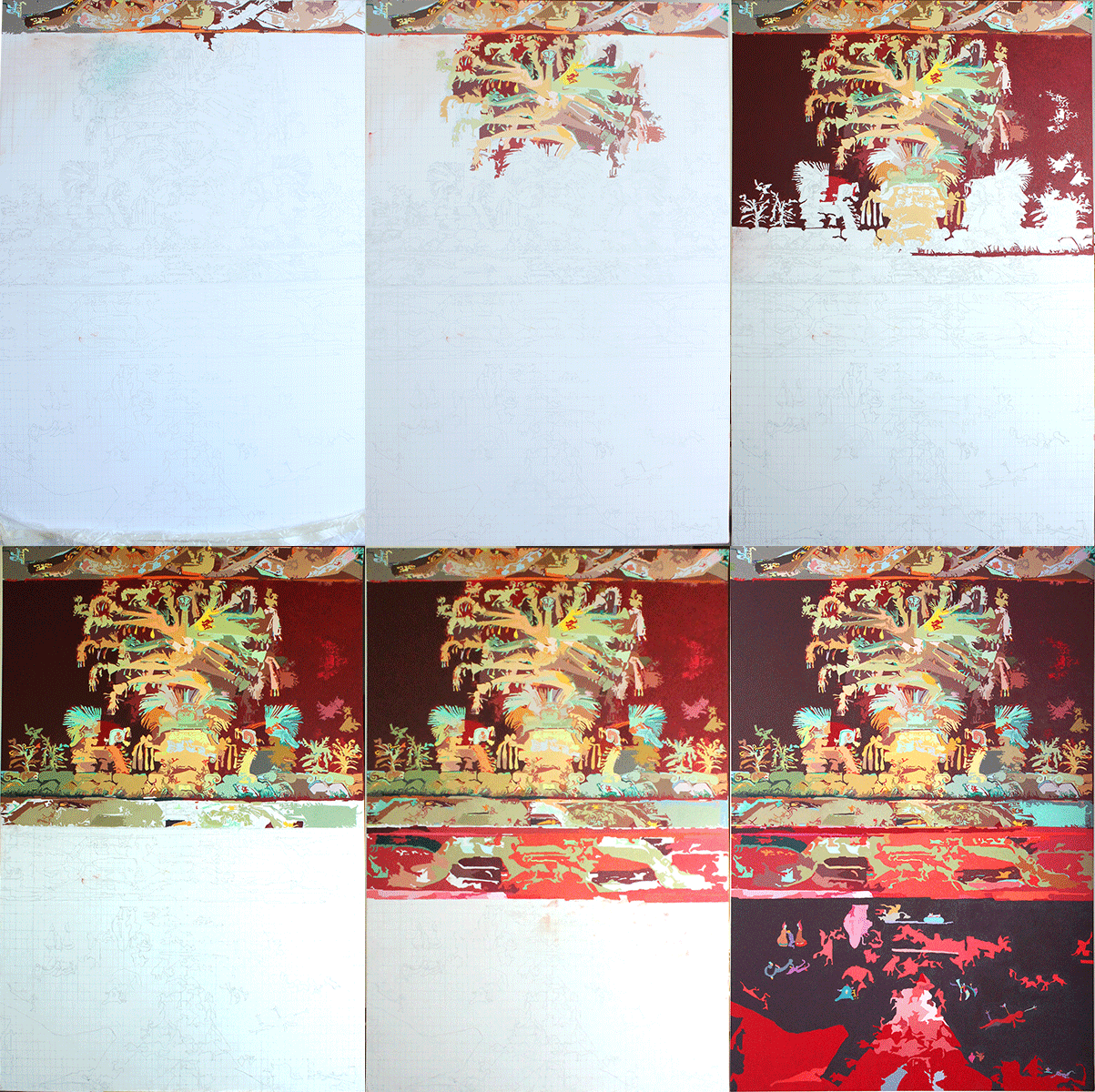
This work draws its genesis from the Tlalocan mural at Tepantitla, Teotihuacan, yet it functions neither as an archaeological record nor as a devotional reproduction.
Here, the Pre-Hispanic image operates as a perceptual matrix. Its original visual language—crisp linework, flat chromatic planes, and segmented composition—already functions as a code that deconstructs the illusion of depth to prioritize symbolic structure. The pictorial intervention does not append historical narrative; rather, it activates the visual grammar latent within the mural, exposing how an ancient civilization constructed its reality through the codified observation of nature.
The composition is organized into horizontal registers separating the celestial, the terrestrial, and the underworld, yet it entirely dismantles any traditional narrative hierarchy. Each zone is resolved through planes of pure color and defined contours that compel the eye to actively reconstruct spatial relationships. The palette vibrates between telluric reds, verdant greens, and aqueous blues, translating the Mesoamerican cosmogony not as a static myth, but as a dynamic system of perception in constant motion. The lateral figures and the central presence of the rain god do not represent fixed dogmas; they demonstrate the mechanism through which the observed is transmuted into meaning.
Through the lens of the Generative Gaze, this piece establishes that ancient and contemporary perception share the exact same operative principle: reality is actualized when a gaze structures it. The Teotihuacan mural already functioned under the axiom that to observe is to synthesize chaos into form. The contemporary iteration does not merely replicate that act; it renders it visible. By subjecting the image to a process of deconstruction and chromatic recomposition, the work exposes that no visual system captures an objective truth. All construct worlds through selection, excision, and the assignment of value to the observed. Tlalocan ceases to be a mythical paradise, transmuting instead into a field of perceptual operations where history, symbol, and gaze converge within a singular, generative act of creation.
Size:
35.43" x 47.24"
Technique::
Oil on canvas.