
The Metamorphosis of the Young Picasso
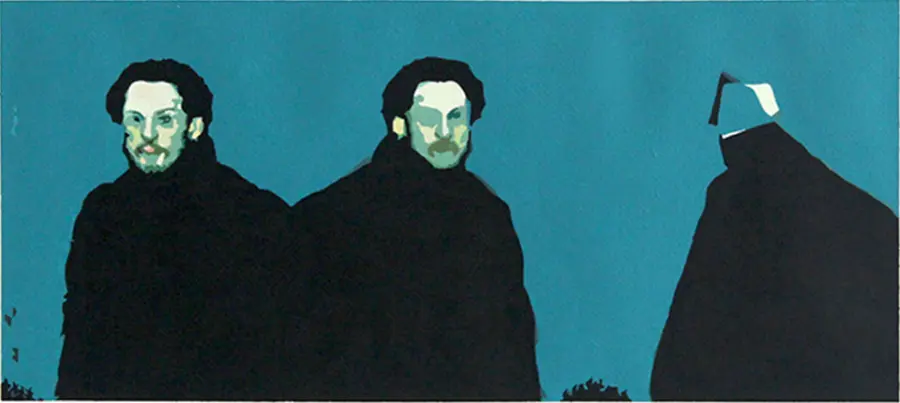
Anchored in a dramatic 1901 self-portrait by Pablo Picasso from his Blue Period, this work eschews static replication to function as a perceptual sequence that anticipates the Spanish master's own morphological evolution.
The composition unfolds across three distinct phases of a single figure: transitioning from a recognizable visage to its ultimate dissolution into a dark, abstract silhouette. This progression does not merely illustrate the passage of time; it exposes the ontological instability of identity and form. The reality of the subject is not a fixed datum, but a continuous process of transformation actualizing before the viewer's eyes.
Employing acrylic—a fast-drying medium characterized by crisp, defined planes—reinforces the concept of the image's modular construction. The piece perfectly exemplifies the Generative Gaze by positing that we do not perceive Picasso as he historically was, but rather as our cognition reconstructs and projects him into what he is destined to become. The metamorphosis does not occur on the physical substrate of the paper; it unfolds entirely within the perceptual field of the observer, who witnesses the figure dissolve and transmute into an entirely new entity.
Size:
Paper: 27.55" x 19.68"
Pictorial Mass: 18.70" x 8.54"
Technique:
Acrylic on paper.
The Metamorphosis of the Young Picasso
Anchored in a dramatic 1901 self-portrait by Pablo Picasso from his Blue Period, this work eschews static replication to function as a perceptual sequence that anticipates the Spanish master's own morphological evolution.
The composition unfolds across three distinct phases of a single figure: transitioning from a recognizable visage to its ultimate dissolution into a dark, abstract silhouette. This progression does not merely illustrate the passage of time; it exposes the ontological instability of identity and form. The reality of the subject is not a fixed datum, but a continuous process of transformation actualizing before the viewer's eyes.
Employing acrylic—a fast-drying medium characterized by crisp, defined planes—reinforces the concept of the image's modular construction. The piece perfectly exemplifies the Generative Gaze by positing that we do not perceive Picasso as he historically was, but rather as our cognition reconstructs and projects him into what he is destined to become. The metamorphosis does not occur on the physical substrate of the paper; it unfolds entirely within the perceptual field of the observer, who witnesses the figure dissolve and transmute into an entirely new entity.
Size:
Paper: 27.55" x 19.68"
Pictorial Mass: 18.70" x 8.54"
Technique:
Acrylic on paper.