
The Forgotten Children of Saturn
This work is erected upon the very foundations that construct war: unyielding convictions, greed, the lust for power, and the reification of the Other.
Under this logic, armed conflict assumes its monstrous morphology, devouring its own progeny much like the myth of Saturn. Childhood and youth—stages inherently destined for discovery—are transformed into the theater of a nightmare where the most unflinching visage of existence is laid bare.
The painting denounces the cycle of systemic oblivion. Once armistices and peace treaties are signed, the traces of suffering and trauma are allowed to dissolve in the name of mere continuity. Confronting this collective amnesia, the work rises as an act of radical resistance: Let it not be forgotten! Let it not be forgiven! The words of George Santayana greeting visitors at Auschwitz ("Those who cannot remember the past are condemned to repeat it") resonate here as an inexorable indictment.
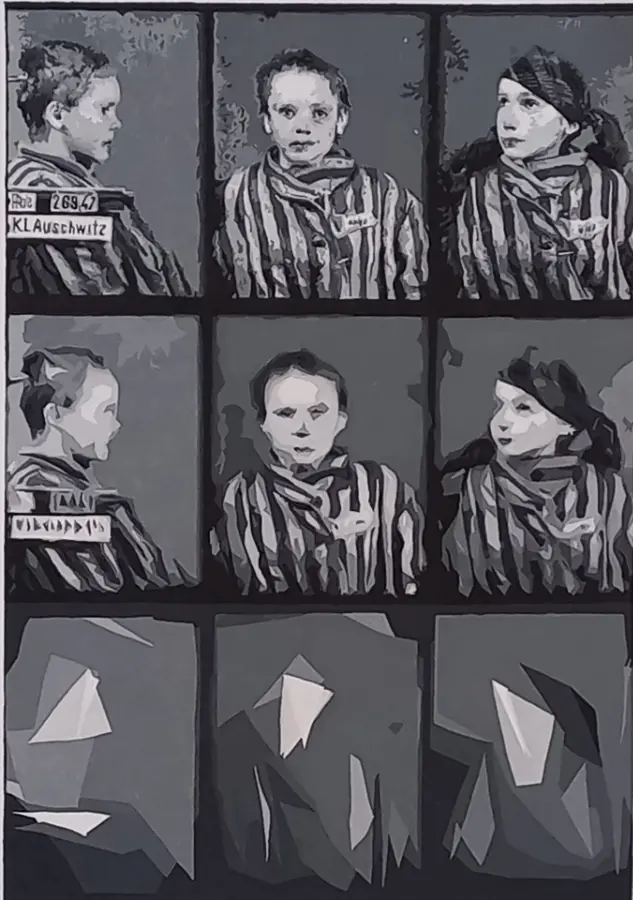
The gravitational center of the piece is Czesława Kwoka, a 14-year-old Polish Catholic girl murdered in Auschwitz on March 12, 1943. The imagery originates from the bureaucratic intake photographs taken by Wilhelm Brasse. The composition is organized within a strict grid where the upper panels anchor the victim's visage, while the lower ones dissolve into abstract, geometric forms, suggesting a structural disintegration of memory.
This visual architecture operationalizes the tension between memory and oblivion. The upper panels sustain Czesława's identity before the viewer, while the lower ones represent the dissolution to which time and indifference condemn the victims. The work refuses to allow the lower abstraction to consume the figure. Instead, the active gaze of the observer halts on the girl's eyes, anchoring her presence in the present and refusing to let oblivion complete its mechanism of erasure. Czesława's reality does not reside in the historical past of 1943, but in the perpetual dialectic between a face that resists dissolution and an abstraction that threatens to engulf it.
The Children of Saturn" (To the children of war).
The World devoured you.
The colossal wave of soulless reason’s fever
engulfed you without pity.
A gargantuan tide of arid stone
crashed down upon you.
Fires in your azure landscapes.
Machines thundering over the mud of your paths.
While the future fled to other skies,
Saturn barked: Order! Rules! More order, more rules!
Reason! Reason!
That was the reason your souls were trampled
to be reduced to mere things.
Things to be cataloged and numbered.
Things devoid of a soul.
Who desires a soulless reason?
A soulless force that seeks to obliterate all that breathes Life?
Triumph of soulless reason.
Triumph of your Death.
Death to Life,
Life to Reason.
Life to Life...
Forgotten children of Saturn.
Devoured by the World.
Lost souls.
Luis Barquero Vernet
Size:
15.74" x 22.44"
Technique:
Acrylic on paper.
The Forgotten Children of Saturn
This work is erected upon the very foundations that construct war: unyielding convictions, greed, the lust for power, and the reification of the Other.
Under this logic, armed conflict assumes its monstrous morphology, devouring its own progeny much like the myth of Saturn. Childhood and youth—stages inherently destined for discovery—are transformed into the theater of a nightmare where the most unflinching visage of existence is laid bare.
The painting denounces the cycle of systemic oblivion. Once armistices and peace treaties are signed, the traces of suffering and trauma are allowed to dissolve in the name of mere continuity. Confronting this collective amnesia, the work rises as an act of radical resistance: Let it not be forgotten! Let it not be forgiven! The words of George Santayana greeting visitors at Auschwitz ("Those who cannot remember the past are condemned to repeat it") resonate here as an inexorable indictment.
The gravitational center of the piece is Czesława Kwoka, a 14-year-old Polish Catholic girl murdered in Auschwitz on March 12, 1943. The imagery originates from the bureaucratic intake photographs taken by Wilhelm Brasse. The composition is organized within a strict grid where the upper panels anchor the victim's visage, while the lower ones dissolve into abstract, geometric forms, suggesting a structural disintegration of memory.
This visual architecture operationalizes the tension between memory and oblivion. The upper panels sustain Czesława's identity before the viewer, while the lower ones represent the dissolution to which time and indifference condemn the victims. The work refuses to allow the lower abstraction to consume the figure. Instead, the active gaze of the observer halts on the girl's eyes, anchoring her presence in the present and refusing to let oblivion complete its mechanism of erasure. Czesława's reality does not reside in the historical past of 1943, but in the perpetual dialectic between a face that resists dissolution and an abstraction that threatens to engulf it.
The Children of Saturn"
(To the children of war).
The World devoured you.
The colossal wave of soulless reason’s fever
engulfed you without pity.
A gargantuan tide of arid stone
crashed down upon you.
Fires in your azure landscapes.
Machines thundering over the mud of your paths.
While the future fled to other skies,
Saturn barked: Order! Rules! More order, more rules!
Reason! Reason!
That was the reason your souls were trampled
to be reduced to mere things.
Things to be cataloged and numbered.
Things devoid of a soul.
Who desires a soulless reason?
A soulless force that seeks to obliterate all that breathes Life?
Triumph of soulless reason.
Triumph of your Death.
Death to Life,
Life to Reason.
Life to Life...
Forgotten children of Saturn.
Devoured by the World.
Lost souls.
Luis Barquero Vernet
Size:
15.74" x 22.44"
Technique:
Acrylic on paper.