
Arrival of the Bus at San Miguel
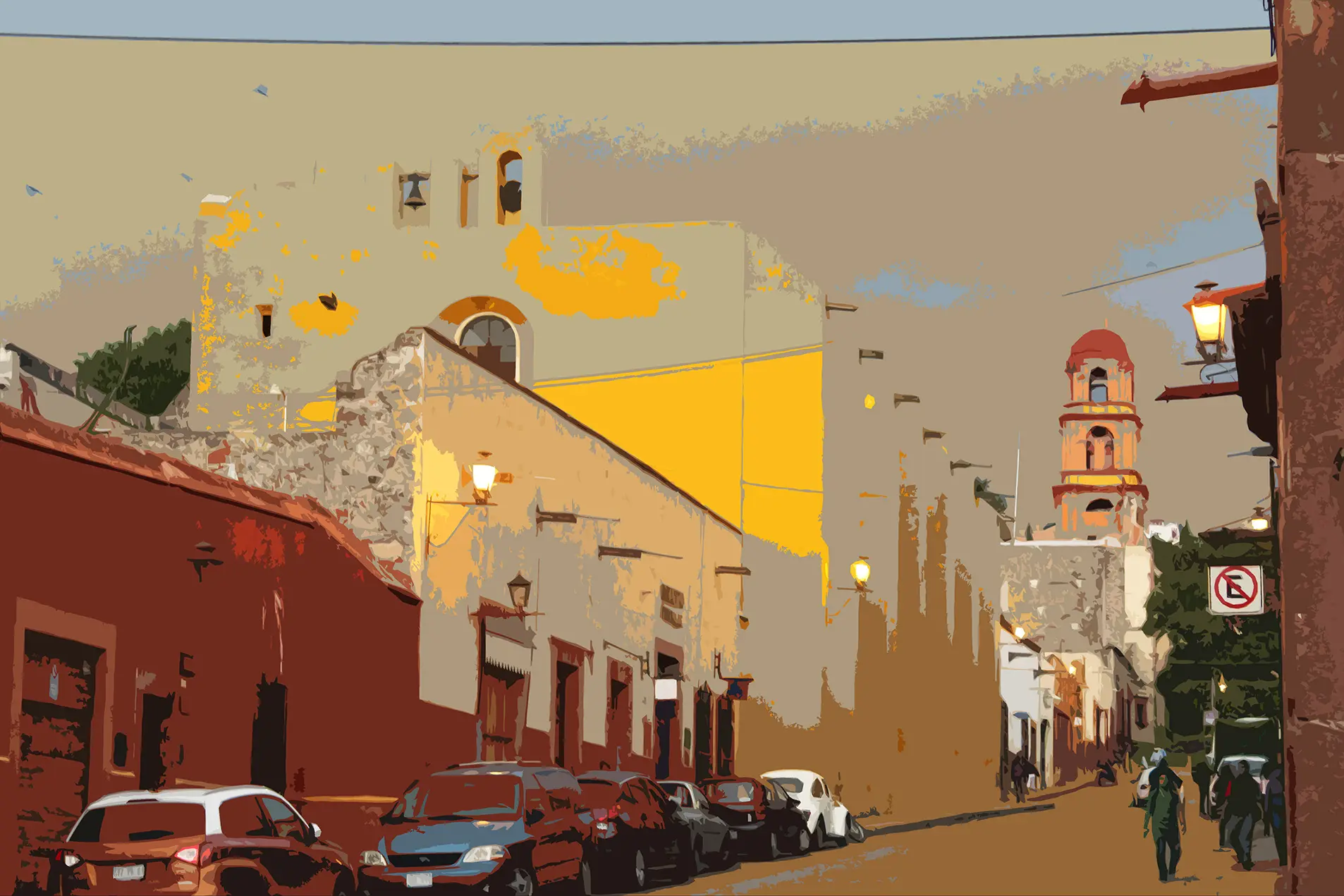
Anchored in an incidental snapshot taken at the bus station in San Miguel de Allende, this work’s true subject is not the urban scene itself, but the latent tension of a critical threshold.
At the exact moment the image was captured, the artist was the target of a thwarted robbery attempt by the very individual depicted in the painting. This event, narrowly averted at the last possible second, radically transformed the perception of the environment: shifting it from a mundane topography into a space saturated with an invisible, menacing energy.
The reflection arising from this incident forms the conceptual nucleus of the piece: How do our lives navigate in tranquil equilibrium mere moments before a disaster? And, more crucially, does the landscape absorb the kinetic charge of a hostile intention? The artist answers in the affirmative through the act of painting. What is rendered here is neither the colonial architecture nor the afternoon light, but rather the uncanny atmospheric charge that saturated the air at that precise instant—that subtle, high-frequency vibration that precedes conflict, perceptible only to the one experiencing it.
From a curatorial standpoint, the work demonstrates that reality is neither a passive nor a neutral stage. The environment actively absorbs and reflects the intentions, fears, and decisions of those who inhabit it. The painting’s palette and texture eschew photographic fidelity, seeking instead to visually translate that profound atmosphere of imminence and hyper-vigilance.
Arrival of the Bus at San Miguel perfectly exemplifies the core tenet of the Generative Gaze: reality does not exist as an objective, independent fact, but is continuously constructed and tinted by the emotional and perceptual charge of the observer. Here, the landscape is not a mere witness; it is an active participant that manifests differently according to the internal energy of the one who looks upon it.
Size:
47.63" x 31.88"
Technique:
Oil on canvas.
Arrival of the Bus at San Miguel
Anchored in an incidental snapshot taken at the bus station in San Miguel de Allende, this work’s true subject is not the urban scene itself, but the latent tension of a critical threshold.
At the exact moment the image was captured, the artist was the target of a thwarted robbery attempt by the very individual depicted in the painting. This event, narrowly averted at the last possible second, radically transformed the perception of the environment: shifting it from a mundane topography into a space saturated with an invisible, menacing energy.
The reflection arising from this incident forms the conceptual nucleus of the piece: How do our lives navigate in tranquil equilibrium mere moments before a disaster? And, more crucially, does the landscape absorb the kinetic charge of a hostile intention? The artist answers in the affirmative through the act of painting. What is rendered here is neither the colonial architecture nor the afternoon light, but rather the uncanny atmospheric charge that saturated the air at that precise instant—that subtle, high-frequency vibration that precedes conflict, perceptible only to the one experiencing it.
From a curatorial standpoint, the work demonstrates that reality is neither a passive nor a neutral stage. The environment actively absorbs and reflects the intentions, fears, and decisions of those who inhabit it. The painting’s palette and texture eschew photographic fidelity, seeking instead to visually translate that profound atmosphere of imminence and hyper-vigilance.
Arrival of the Bus at San Miguel perfectly exemplifies the core tenet of the Generative Gaze: reality does not exist as an objective, independent fact, but is continuously constructed and tinted by the emotional and perceptual charge of the observer. Here, the landscape is not a mere witness; it is an active participant that manifests differently according to the internal energy of the one who looks upon it.
Size:
47.63" x 31.88"
Technique:
Oil on canvas.