
Sato-goro koko
"Twilight in the Village"
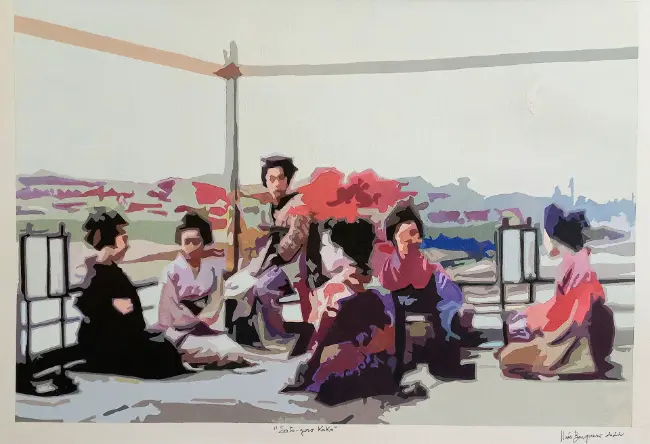
Originating from a deep engagement with Eastern aesthetics, specifically the late Edo-period Japanese tradition, this work operates as a variation of Musubi shiki (The Ceremony of the Bond), previously executed in oil on canvas. Yet, the proposition here transcends mere replication: the figures are no longer sequestered indoors for a ceremonial rite; rather, they inhabit the expansive respite of a terrace overlooking the sea or a vast river, shifting the spatial dynamic from an intimate interior to an open, boundless landscape.
The experiment transitions to acrylic on paper in a reduced format, stress-testing the theoretical frameworks of the series. This medium facilitates the construction of the scene through discrete chromatic planes and resolute contrasts: the kimonos are resolved into modular blocks of black, pink, violet, and deep crimson, while the background dissolves into pastel gradients that suggest a distant horizon without rigidly delineating it.
Each figure operates as a deliberate perceptual decision rather than a documentary record. The artist’s gaze does not passively copy the source photograph, but actively reinterprets it: simplifying, emphasizing, and omitting. The women are not merely 'portrayed'; they are actively constructedthrough a contemporary sensibility that engages in a dynamic dialogue with an ancestral aesthetic.
Ultimately, this piece validates the core tenet of the Generative Gaze: reality is not a static object demanding faithful reproduction, but a highly malleable substrate that is continuously transformed each time it is observed and reinterpreted.
Size:
Paper: 27.55" x 19.68"
Pictorial Mass: 19.68" x 13.77"
Técnica:
Acrylic on paper.
Sato-goro koko
"Twilight in the Village"
Originating from a deep engagement with Eastern aesthetics, specifically the late Edo-period Japanese tradition, this work operates as a variation of Musubi shiki (The Ceremony of the Bond), previously executed in oil on canvas. Yet, the proposition here transcends mere replication: the figures are no longer sequestered indoors for a ceremonial rite; rather, they inhabit the expansive respite of a terrace overlooking the sea or a vast river, shifting the spatial dynamic from an intimate interior to an open, boundless landscape.
The experiment transitions to acrylic on paper in a reduced format, stress-testing the theoretical frameworks of the series. This medium facilitates the construction of the scene through discrete chromatic planes and resolute contrasts: the kimonos are resolved into modular blocks of black, pink, violet, and deep crimson, while the background dissolves into pastel gradients that suggest a distant horizon without rigidly delineating it.
Each figure operates as a deliberate perceptual decision rather than a documentary record. The artist’s gaze does not passively copy the source photograph, but actively reinterprets it: simplifying, emphasizing, and omitting. The women are not merely 'portrayed'; they are actively constructedthrough a contemporary sensibility that engages in a dynamic dialogue with an ancestral aesthetic.
Ultimately, this piece validates the core tenet of the Generative Gaze: reality is not a static object demanding faithful reproduction, but a highly malleable substrate that is continuously transformed each time it is observed and reinterpreted.
Size:
Paper: 27.55" x 19.68"
Pictorial Mass: 19.68" x 13.77"
Técnica:
Acrylic on paper.