
Oneiró
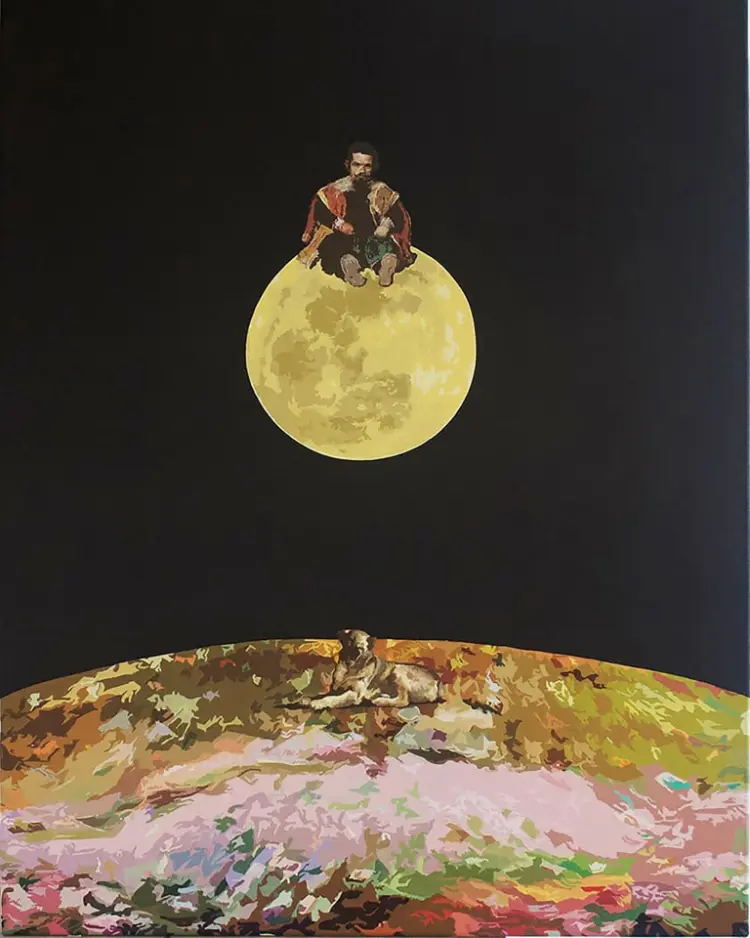
Oneiró," roughly translating to "dreamscape," inhabits the liminal threshold between the deconstruction of icons and the pursuit of the invisible.
While its visual DNA references Diego Velázquez—specifically the jester El Primo and the mastiff Salomón from Las Meninas—alongside a lower stratum evoking Claude Monet’s gardens, the composition eschews mere stylistic variation. The work does not reproduce a known imaginary; rather, it constructs an affective topology ex nihilo.
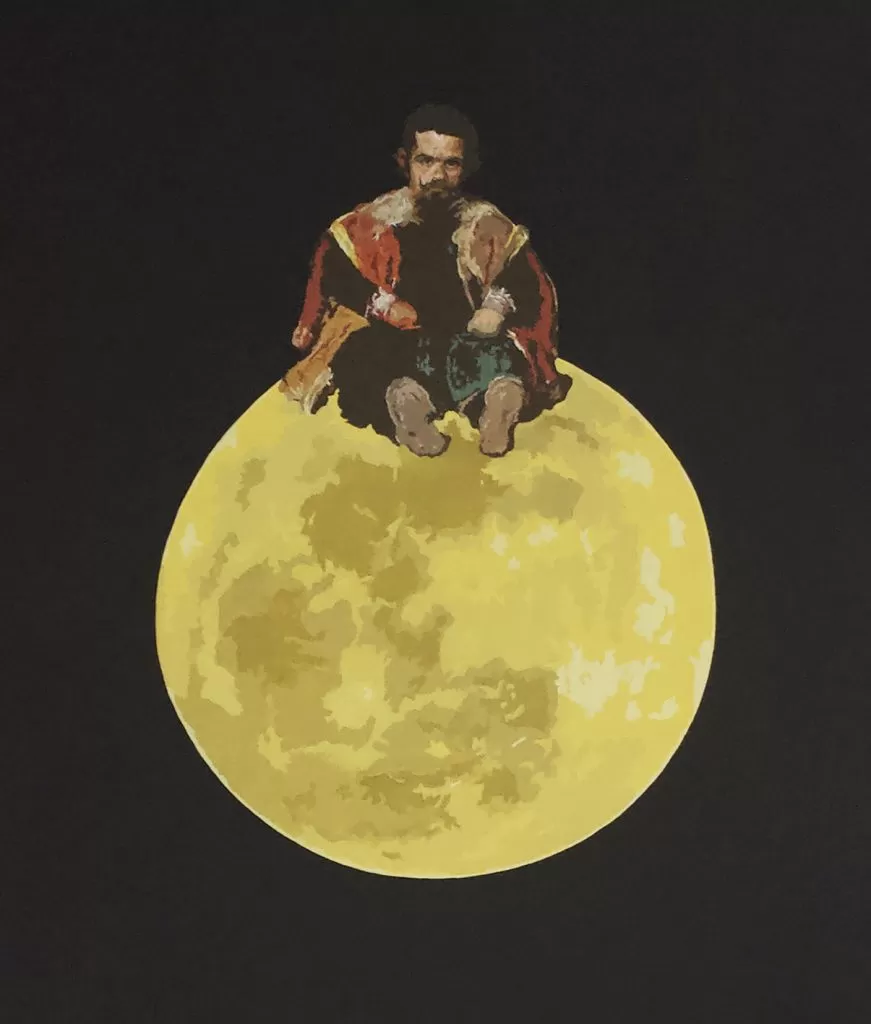
The genesis of this piece coincides with the initial stupor of the COVID-19 pandemic, an epoch in which the world was thrust into a dystopian script of lockdown and collective dread. The painting translates this profound sense of unreality and forced isolation. The figure of El Primo, transmuted into a solitary giant, sits upon his own moon. From this astronomical distance, he observes with an impotent gaze the vibrant, terrestrial landscape below—a beautiful world suddenly rendered inaccessible.
The presence of the mastiff Salomón on the terrestrial plane introduces a dimension of literary yearning. The imagery evokes The True History of the Dog Salomón, in which Ginés Luciente, servant to Quevedo, resorts to magic to transform into the hound, thereby accompanying his unreachable beloved. On the canvas, the dog and the jester share this same unbridgeable distance, united by the desperate imperative to traverse the void.
When physical proximity dissipates, the gaze stretches across the abyss to sustain what the hands can no longer touch. The moon ceases to be a celestial body, transmuting into a raft of pure perception adrift in the darkness. To observe from such a distance demands the acceptance that when reality becomes untouchable, it survives solely within the tense, magnetic field suspended between the contemplating eye and the world resisting physical apprehension.
Size:
36.61" x 47.24"
Technique:
Oil on canvas.
This work resides within a private collection in Spain.
Oneiró
Oneiró," roughly translating to "dreamscape," inhabits the liminal threshold between the deconstruction of icons and the pursuit of the invisible.
While its visual DNA references Diego Velázquez—specifically the jester El Primo and the mastiff Salomón from Las Meninas—alongside a lower stratum evoking Claude Monet’s gardens, the composition eschews mere stylistic variation. The work does not reproduce a known imaginary; rather, it constructs an affective topology ex nihilo.
The genesis of this piece coincides with the initial stupor of the COVID-19 pandemic, an epoch in which the world was thrust into a dystopian script of lockdown and collective dread. The painting translates this profound sense of unreality and forced isolation. The figure of El Primo, transmuted into a solitary giant, sits upon his own moon. From this astronomical distance, he observes with an impotent gaze the vibrant, terrestrial landscape below—a beautiful world suddenly rendered inaccessible.
The presence of the mastiff Salomón on the terrestrial plane introduces a dimension of literary yearning. The imagery evokes The True History of the Dog Salomón, in which Ginés Luciente, servant to Quevedo, resorts to magic to transform into the hound, thereby accompanying his unreachable beloved. On the canvas, the dog and the jester share this same unbridgeable distance, united by the desperate imperative to traverse the void.
When physical proximity dissipates, the gaze stretches across the abyss to sustain what the hands can no longer touch. The moon ceases to be a celestial body, transmuting into a raft of pure perception adrift in the darkness. To observe from such a distance demands the acceptance that when reality becomes untouchable, it survives solely within the tense, magnetic field suspended between the contemplating eye and the world resisting physical apprehension.
Size:
36.61" x 47.24"
Technique:
Oil on canvas.
This work resides within a private collection in Spain.