
The Mith
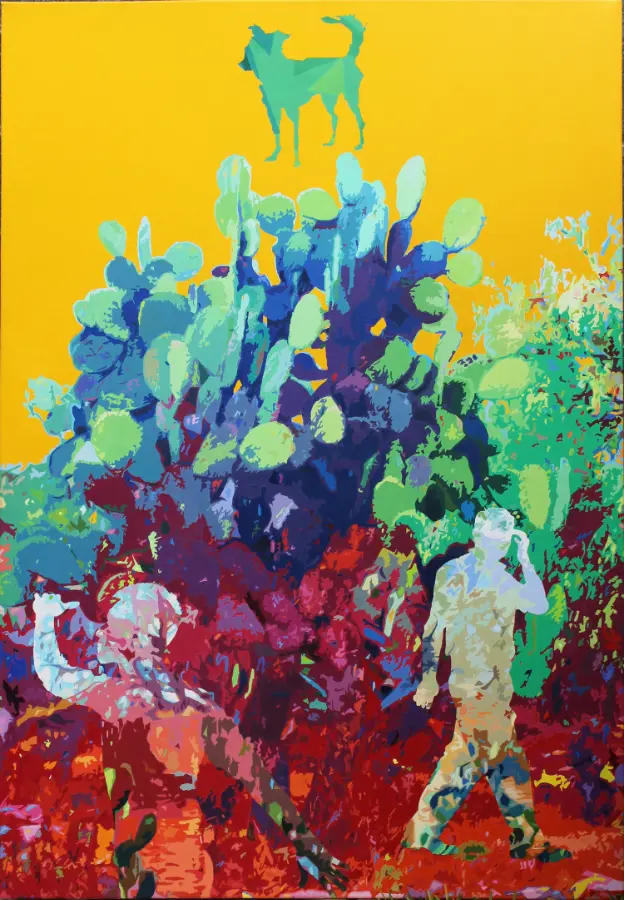
This work operates as a visual analogy for the mental and cultural constructs that condition our perception of identity. The Myth alludes to the institutional narrative, ingrained from childhood, which persuades us that we are autonomous entities, severed from the broader ecological web. This belief, far from an absolute truth, functions as a perceptual filter that alienates us from our natural state. It drives a misguided search for a "true identity" in external paradigms, often leading to the devaluation of one's own culture in deference to hegemonic systems presumed to be superior.
Visually, the composition dismantles the traditional hierarchy between figure and ground. The human silhouettes, rendered with a spectral, translucent quality, do not dominate the landscape. Instead, they coexist and dissolve into the vibrant, pulsing presence of the nopal (prickly pear cactus) and the intense yellow field. This pictorial decision is deliberate: it posits that separation is merely an optical and cognitive illusion. The human subject is not superimposed upon the environment; it is synthesized from the very same material that surrounds it.
Through the lens of the Generative Gaze, the work challenges the validity of imposed realities. If perception actively constructs reality, then shifting the gaze—transitioning from the paradigm of the isolated individual to that of an integral node within an ecosystem—radically reconfigures existence. The Myth reveals that we need not seek our essence in foreign paradigms or in mirrors distorted by societal conditioning. It suffices to observe our immediate surroundings and recognize that the concepts of "environment" and "being" are, ultimately, synonymous. True identity is not a destination to be found; it is a phenomenon to be perceived, the precise moment we cease viewing the world through the lens of the myth.
Size:
47.24" x 70.86"
Technique:
Oil on canvas.
The Mith
This work operates as a visual analogy for the mental and cultural constructs that condition our perception of identity. The Myth alludes to the institutional narrative, ingrained from childhood, which persuades us that we are autonomous entities, severed from the broader ecological web. This belief, far from an absolute truth, functions as a perceptual filter that alienates us from our natural state. It drives a misguided search for a "true identity" in external paradigms, often leading to the devaluation of one's own culture in deference to hegemonic systems presumed to be superior.
Visually, the composition dismantles the traditional hierarchy between figure and ground. The human silhouettes, rendered with a spectral, translucent quality, do not dominate the landscape. Instead, they coexist and dissolve into the vibrant, pulsing presence of the nopal (prickly pear cactus) and the intense yellow field. This pictorial decision is deliberate: it posits that separation is merely an optical and cognitive illusion. The human subject is not superimposed upon the environment; it is synthesized from the very same material that surrounds it.
Through the lens of the Generative Gaze, the work challenges the validity of imposed realities. If perception actively constructs reality, then shifting the gaze—transitioning from the paradigm of the isolated individual to that of an integral node within an ecosystem—radically reconfigures existence. The Myth reveals that we need not seek our essence in foreign paradigms or in mirrors distorted by societal conditioning. It suffices to observe our immediate surroundings and recognize that the concepts of "environment" and "being" are, ultimately, synonymous. True identity is not a destination to be found; it is a phenomenon to be perceived, the precise moment we cease viewing the world through the lens of the myth.
Size:
47.24" x 70.86"
Technique:
Oil on canvas.