
Salvador Dalí
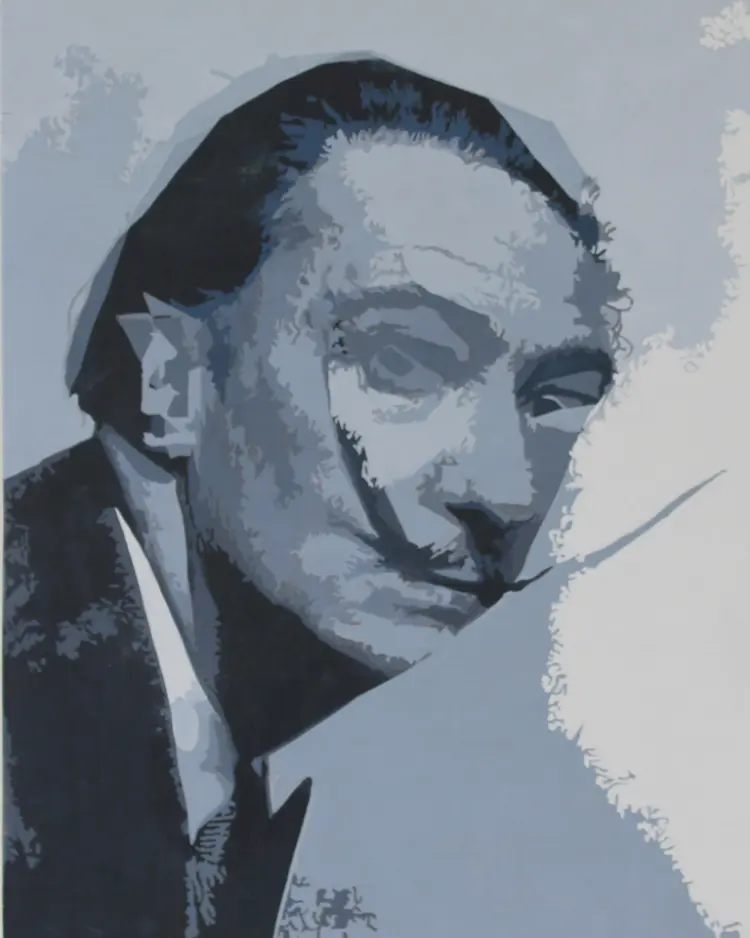
The selection of Salvador Dalí as the subject is far from arbitrary. His status as the master of the oneiric and his shared Catalan origin with the artist align the image perfectly with the experiment's core objective: to subject the recognizable to a process of radical defamiliarization.
The work originates from a Philippe Halsman photograph—a document capturing the figure in his most iconic iteration—which is then subjected to a series of digital distortion algorithms. The objective of this technological manipulation is not to obliterate the image, but to push it to the precise threshold where the motif ceases to be a faithful portrait and transmutes into an unstable perceptual construct. The distortion halts at the exact moment before the visage loses its identity, lingering in that fragile liminal space where the viewer’s brain struggles to assemble the deformed fragments into a coherent gestalt.
Once the digital image is generated, the process reverses its vector: the computer screen becomes the reference model, yet it is executed using the most traditional academic methodologies. Oil on raw wood panel, the easel, and the manual brushstroke replace the pixel. This translation from the digital to the analog is not a mere technical reproduction, but an act of material appropriation. The clinical coldness of the computational distortion is warmed by its contact with physical pigment and the tactile topography of the wood.
Dalí dedicated his life to demonstrating that reality is a malleable convention. This work takes that premise a step further: it does not paint the surreal; it paints the distortion itself. The twisted mustache and the oblique gaze are no longer mere physical traits, but the coordinates of a topological map the viewer must navigate. Ultimately, what remains on the panel is not the visage of a man, but the trace of a gaze that dared to warp reality twice: first through an algorithm, then through a brush. It demonstrates that the truth of an image never resides in its surface, but in the cognitive tension between what is rendered and what is imagined.
Size:
15.74" x 23.62"
Technique:
Oil on canvas.
Salvador Dalí
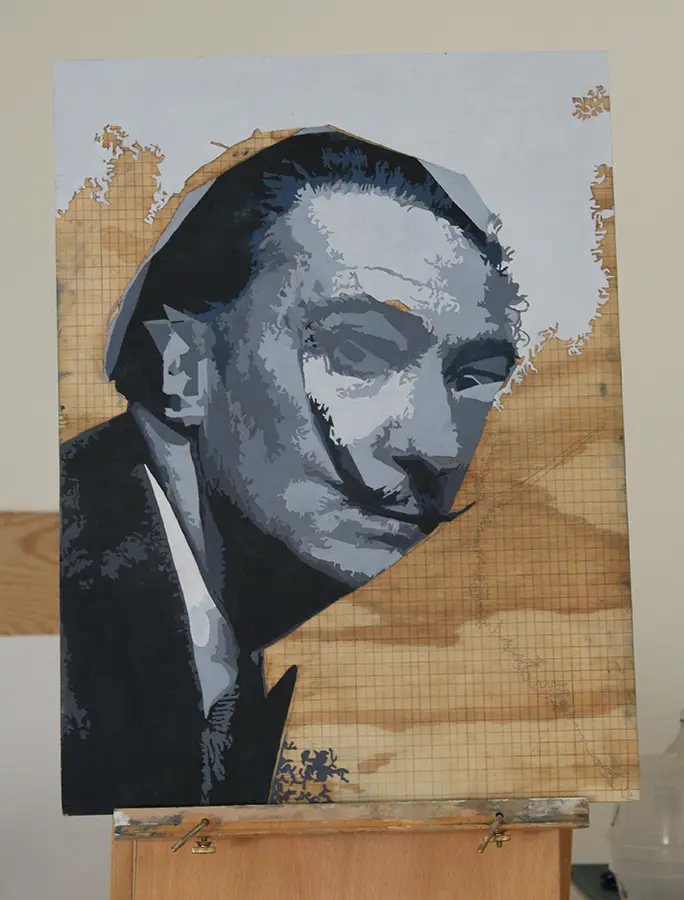
The selection of Salvador Dalí as the subject is far from arbitrary. His status as the master of the oneiric and his shared Catalan origin with the artist align the image perfectly with the experiment's core objective: to subject the recognizable to a process of radical defamiliarization.
The work originates from a Philippe Halsman photograph—a document capturing the figure in his most iconic iteration—which is then subjected to a series of digital distortion algorithms. The objective of this technological manipulation is not to obliterate the image, but to push it to the precise threshold where the motif ceases to be a faithful portrait and transmutes into an unstable perceptual construct. The distortion halts at the exact moment before the visage loses its identity, lingering in that fragile liminal space where the viewer’s brain struggles to assemble the deformed fragments into a coherent gestalt.
Once the digital image is generated, the process reverses its vector: the computer screen becomes the reference model, yet it is executed using the most traditional academic methodologies. Oil on raw wood panel, the easel, and the manual brushstroke replace the pixel. This translation from the digital to the analog is not a mere technical reproduction, but an act of material appropriation. The clinical coldness of the computational distortion is warmed by its contact with physical pigment and the tactile topography of the wood.
Dalí dedicated his life to demonstrating that reality is a malleable convention. This work takes that premise a step further: it does not paint the surreal; it paints the distortion itself. The twisted mustache and the oblique gaze are no longer mere physical traits, but the coordinates of a topological map the viewer must navigate. Ultimately, what remains on the panel is not the visage of a man, but the trace of a gaze that dared to warp reality twice: first through an algorithm, then through a brush. It demonstrates that the truth of an image never resides in its surface, but in the cognitive tension between what is rendered and what is imagined.
Size:
15.74" x 23.62"
Technique:
Oil on canvas.