
Pythagorean Music
This work marks a critical inflection point in perceptual exploration.
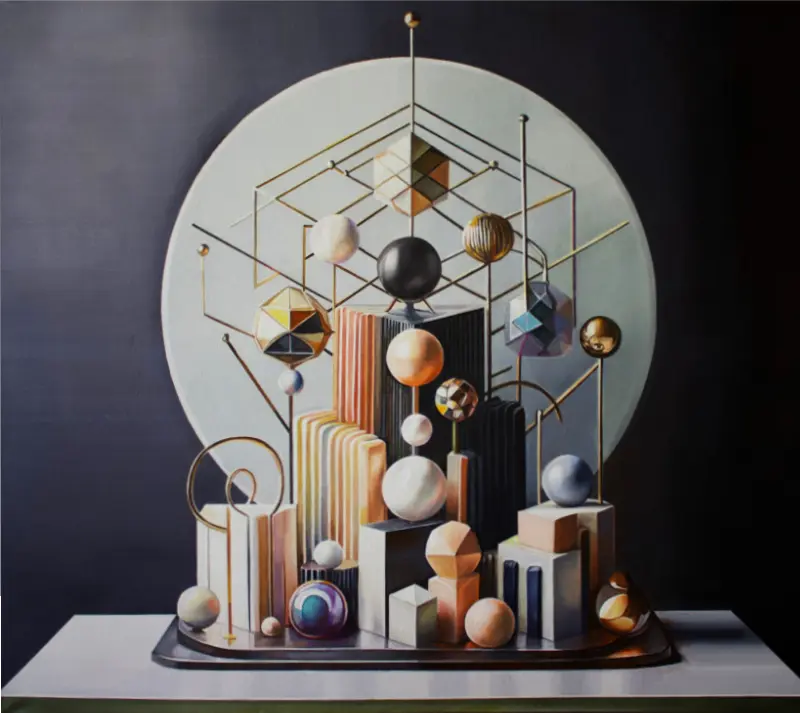
Rather than deconstructing the image to expose its latent semiotics, Pythagorean Music delves into the construction of scenarios where the recognizable is transmuted into the extraordinary. Inspired by the Pythagorean theory of the music of the spheres—which postulates that celestial bodies move according to mathematical proportions that generate an inaudible harmonic resonance—the painting erects an architecture of primary geometric forms. Spheres, cubes, cylinders, and metallic structures are organized with an almost ritualistic exactitude upon a plinth, positioned before a vast luminous circle that functions as an abstract luminary.
The composition actively defies conventional spatial paradigms. Although each discrete element—the metallic sheen, the matte topography, the cast shadow—adheres to rigorous physical laws, their totality does not inhabit any physical reality. This juxtaposition of the familiar and the uncanny disrupts the viewer’s cognitive equilibrium. The work posits that reality is not an immovable absolute, but a highly malleable perceptual consensus. By reconfiguring fragments of our known world into an impossible spatial topology, the painting interrogates the ontological coherence of what we designate as "real."
The visual harmony of the piece operates as a silent score. The proportions, equilibria, and tensions between the volumes do not seek to depict a tangible object, but rather to translate a resonant frequency—an underlying structural order that the mind intuits yet cannot tactilely apprehend.
The spheres do not rotate, yet they vibrate within the silent plane of the canvas. The viewer halts at the precise intersection of a golden edge and a cast shadow, and the inner ear begins to perceive the frequency of the impossible. The work does not merely represent the music of the universe; it actively constructs it in the exact instant the mind accepts that perfect order is, perhaps, the most exquisite form of fiction.
Size:
31.49" x 27.55"
Technique:
Oil on canvas.
Pythagorean Music
This work marks a critical inflection point in perceptual exploration.
Rather than deconstructing the image to expose its latent semiotics, Pythagorean Music delves into the construction of scenarios where the recognizable is transmuted into the extraordinary. Inspired by the Pythagorean theory of the music of the spheres—which postulates that celestial bodies move according to mathematical proportions that generate an inaudible harmonic resonance—the painting erects an architecture of primary geometric forms. Spheres, cubes, cylinders, and metallic structures are organized with an almost ritualistic exactitude upon a plinth, positioned before a vast luminous circle that functions as an abstract luminary.
The composition actively defies conventional spatial paradigms. Although each discrete element—the metallic sheen, the matte topography, the cast shadow—adheres to rigorous physical laws, their totality does not inhabit any physical reality. This juxtaposition of the familiar and the uncanny disrupts the viewer’s cognitive equilibrium. The work posits that reality is not an immovable absolute, but a highly malleable perceptual consensus. By reconfiguring fragments of our known world into an impossible spatial topology, the painting interrogates the ontological coherence of what we designate as "real."
The visual harmony of the piece operates as a silent score. The proportions, equilibria, and tensions between the volumes do not seek to depict a tangible object, but rather to translate a resonant frequency—an underlying structural order that the mind intuits yet cannot tactilely apprehend.
The spheres do not rotate, yet they vibrate within the silent plane of the canvas. The viewer halts at the precise intersection of a golden edge and a cast shadow, and the inner ear begins to perceive the frequency of the impossible. The work does not merely represent the music of the universe; it actively constructs it in the exact instant the mind accepts that perfect order is, perhaps, the most exquisite form of fiction.
Size:
31.49" x 27.55"
Technique:
Oil on canvas.