
Minotaur
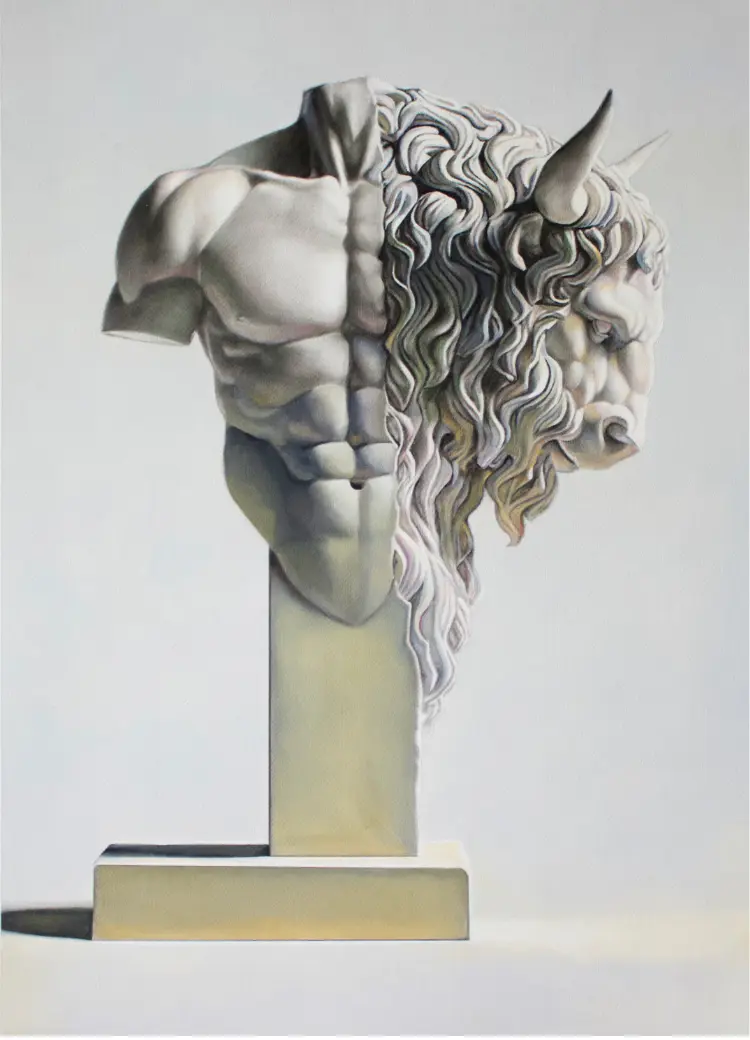
Executed in the dry brush technique—a medium that facilitates a subtle, almost ethereal tonal gradation—this piece integrates into Other Realities by appropriating a visually familiar artifact: the classical bust atop its pedestal. It is then recomposed into a hybrid entity that fundamentally subverts biological logic.
Far from deconstructing the form, the artist constructs it with a rigorous anatomical precision that renders the ontological impossibility of the subject all the more deeply unsettling.
The sculpture manifests a profound ontological fissure: the human torso—the very emblem of Greco-Roman reason and civilization—is organically grafted onto the bestial cranium of the Minotaur. This synthesis is not violent, but strictly structural. The undulating mane and horns are not mere appendages; rather, they are the natural continuation of a musculature that appears taut beneath the marble epidermis. The work materializes the eternal dialectic between animal instinct and the grandeur of the soul, positioning the viewer before the internal architecture of the human condition. Here, the labyrinth is not a physical locus, but the cognitive architecture of the mind itself, wherein these two primal forces cohabit.
The pedestal elevates this contradiction to the status of a monument, endowing it with the solemn dignity of classical statuary. There is no heroic Theseus to vanquish the monster in this composition; the hero and the beast share the same cervical column, the same respiration, the same stone.
This duality is not resolved through victory, but is laid bare as a permanent structural condition. To observe this bust is to recognize that identity is not a binary choice between man and beast, but rather the perpetual tension of inhabiting both corporeal forms simultaneously, sustaining the fragile equilibrium of reason atop its pedestal.
Size:
22.04" x 27.95"
Technique:
Oil on paper.
Minotaur
Executed in the dry brush technique—a medium that facilitates a subtle, almost ethereal tonal gradation—this piece integrates into Other Realities by appropriating a visually familiar artifact: the classical bust atop its pedestal. It is then recomposed into a hybrid entity that fundamentally subverts biological logic.
Far from deconstructing the form, the artist constructs it with a rigorous anatomical precision that renders the ontological impossibility of the subject all the more deeply unsettling.
The sculpture manifests a profound ontological fissure: the human torso—the very emblem of Greco-Roman reason and civilization—is organically grafted onto the bestial cranium of the Minotaur. This synthesis is not violent, but strictly structural. The undulating mane and horns are not mere appendages; rather, they are the natural continuation of a musculature that appears taut beneath the marble epidermis. The work materializes the eternal dialectic between animal instinct and the grandeur of the soul, positioning the viewer before the internal architecture of the human condition. Here, the labyrinth is not a physical locus, but the cognitive architecture of the mind itself, wherein these two primal forces cohabit.
The pedestal elevates this contradiction to the status of a monument, endowing it with the solemn dignity of classical statuary. There is no heroic Theseus to vanquish the monster in this composition; the hero and the beast share the same cervical column, the same respiration, the same stone.
This duality is not resolved through victory, but is laid bare as a permanent structural condition. To observe this bust is to recognize that identity is not a binary choice between man and beast, but rather the perpetual tension of inhabiting both corporeal forms simultaneously, sustaining the fragile equilibrium of reason atop its pedestal.
Size:
22.04" x 27.95"
Technique:
Oil on paper.