
Infanta Margarita of Austria
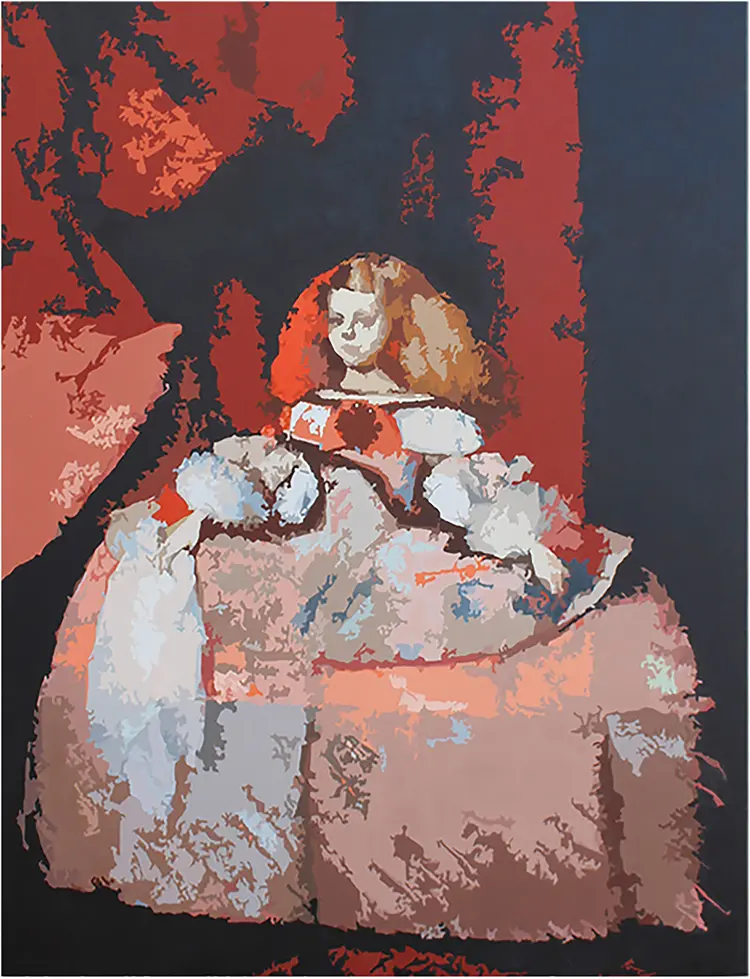
This work interrogates one of the most enduring icons of the cultural imaginary: the Infanta immortalized by Velázquez in Las Meninas, a figure who has since exerted an irresistible gravitational pull on generations of artists and philosophers.
Picasso deconstructed her through a Cubist lens; Dalí rendered her oneiric; Equipo Crónica infused her with political critique; and Foucault positioned her as the very fulcrum of his analysis on representation. None merely copied the Infanta; rather, each radically re-envisioned her through the prism of their own unique perceptual framework.
The portrait housed in the Museo del Prado, currently attributed to Juan Bautista del Mazo (Nota curatorial: se corrige silenciosamente 'Jan' por 'Juan', la grafía histórica correcta), transcends academic debates surrounding its attribution to emerge as an exemplary curatorial paradigm. It demonstrates how a single image can be continuously decoded, reinterpreted, and resignified, contingent upon the historical context and the perceptual sensitivity of the observer. The Infanta is not a static artifact of the seventeenth century; she is a dynamic visual construct, continuously actualized each time an artist chooses to re-engage with her.
Through the lens of the Generative Gaze, this piece exemplifies how cultural icons are never tethered to their epoch of origin. Instead, they exist as latent perceptual potentials, perpetually awaiting activation. Every reinterpretation is not merely a derivative variation of an original, but a distinct, emergent reality synthesized in the very act of observation. Here, the Infanta transcends her historical identity as the daughter of Philip IV to become a reflective surface. She mirrors not the visage of a Baroque princess, but the very gaze of the contemporary observer, refracted through their own present, their emotional landscape, and their creative imperatives.
This capacity for infinite recursive recreation without semantic exhaustion is precisely what elevates the image to a curatorial paradigm. Masterworks are not static monuments; they are generative fields of possibility, perpetually renewing themselves with every act of creation they provoke.
Size:
31.49" x 47.24"
Technique:
Oil on canvas.
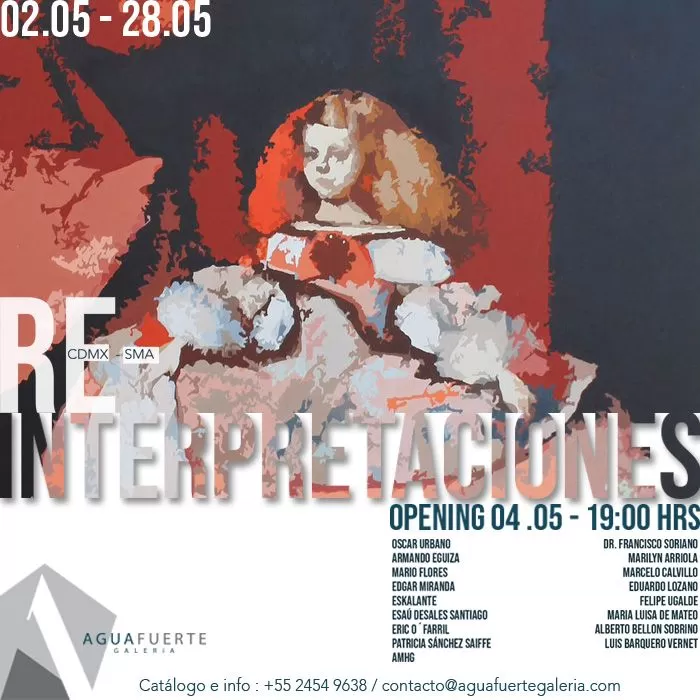
This work was featured in the group exhibition Reinterpretations, presented by Aguafuerte Gallery at its San Miguel de Allende location in May 2023.
Infanta Margarita of Austria
This work interrogates one of the most enduring icons of the cultural imaginary: the Infanta immortalized by Velázquez in Las Meninas, a figure who has since exerted an irresistible gravitational pull on generations of artists and philosophers.
Picasso deconstructed her through a Cubist lens; Dalí rendered her oneiric; Equipo Crónica infused her with political critique; and Foucault positioned her as the very fulcrum of his analysis on representation. None merely copied the Infanta; rather, each radically re-envisioned her through the prism of their own unique perceptual framework.
The portrait housed in the Museo del Prado, currently attributed to Juan Bautista del Mazo (Nota curatorial: se corrige silenciosamente 'Jan' por 'Juan', la grafía histórica correcta), transcends academic debates surrounding its attribution to emerge as an exemplary curatorial paradigm. It demonstrates how a single image can be continuously decoded, reinterpreted, and resignified, contingent upon the historical context and the perceptual sensitivity of the observer. The Infanta is not a static artifact of the seventeenth century; she is a dynamic visual construct, continuously actualized each time an artist chooses to re-engage with her.
Through the lens of the Generative Gaze, this piece exemplifies how cultural icons are never tethered to their epoch of origin. Instead, they exist as latent perceptual potentials, perpetually awaiting activation. Every reinterpretation is not merely a derivative variation of an original, but a distinct, emergent reality synthesized in the very act of observation. Here, the Infanta transcends her historical identity as the daughter of Philip IV to become a reflective surface. She mirrors not the visage of a Baroque princess, but the very gaze of the contemporary observer, refracted through their own present, their emotional landscape, and their creative imperatives.
This capacity for infinite recursive recreation without semantic exhaustion is precisely what elevates the image to a curatorial paradigm. Masterworks are not static monuments; they are generative fields of possibility, perpetually renewing themselves with every act of creation they provoke.
Size:
31.49" x 47.24"
Technique:
Oil on canvas.
This work was featured in the group exhibition Reinterpretations, presented by Aguafuerte Gallery at its San Miguel de Allende location in May 2023.