
The Birth of Venus. (Panel 2)
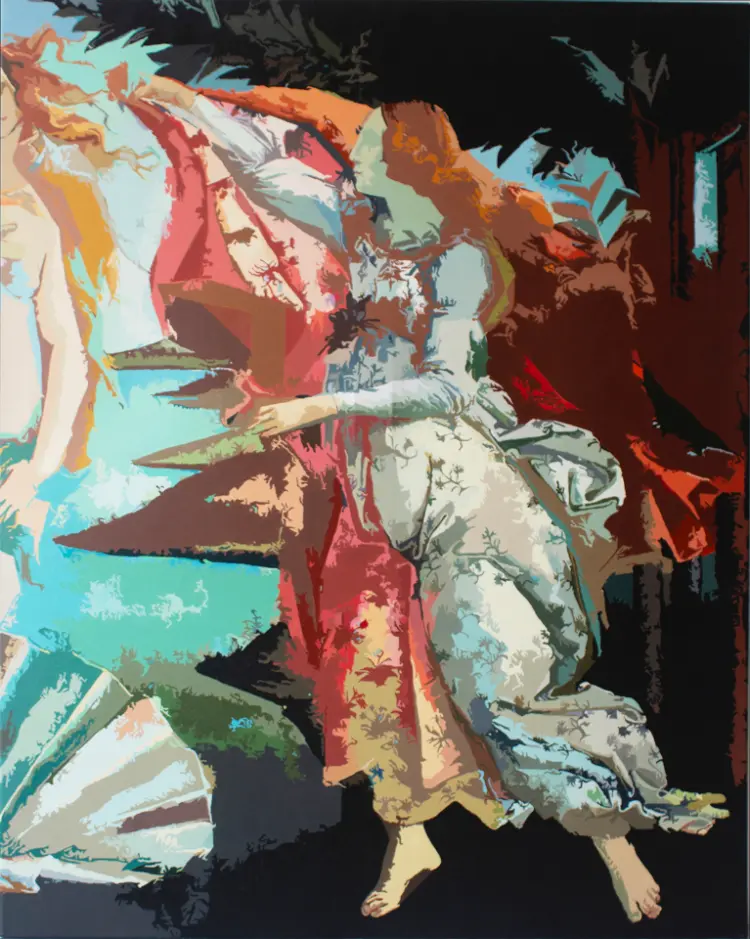
Conceived as Panel 2 of a modular pictorial installation, this work, in concert with Panel 1 and the intermediate fragments, completes the reinterpretation of Sandro Botticelli’s The Birth of Venus (1485–1486).
While Panel 1 established the initial rupture of the central figure as an analogy for the hope society couldextend to missing women, this second panel introduces the vital gesture of covering, protecting, and sheltering—represented by the figure who, in the Renaissance original, extends her mantle over Venus.
The curatorial decision to isolate this gesture within an independent panel is highly deliberate. In Botticelli’s masterpiece, the crimson mantle enveloping Venus symbolizes her terrestrial arrival and divine protection. Here, this very gesture is profoundly resignified: it becomes a metaphor for the sanctuary and security society is morally obligated to provide, yet so frequently denies. The mantle, now fragmented and suspended within the pictorial void, represents an incomplete, interrupted protection—one that fails to fully shroud the vulnerable body.
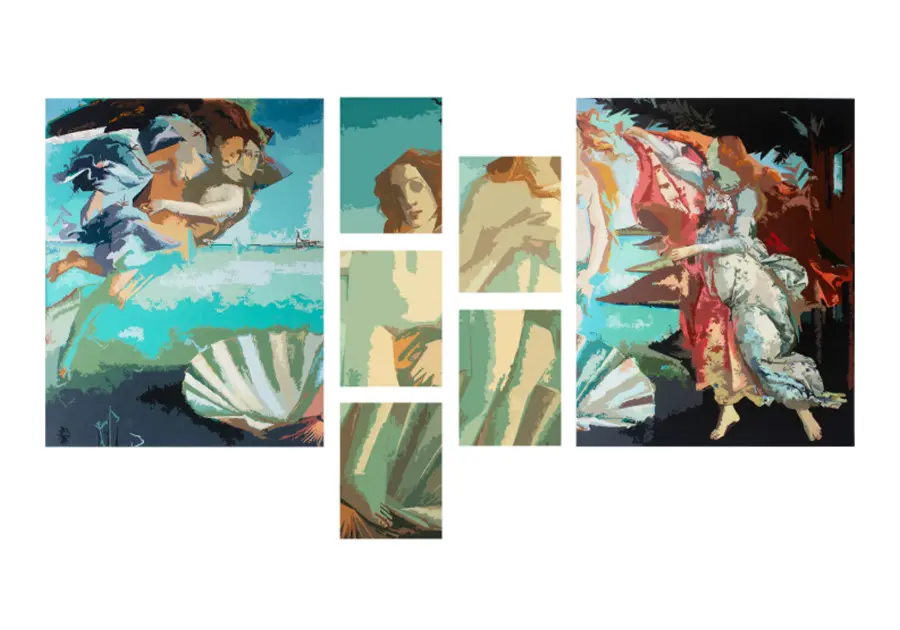
From a curatorial standpoint, Panel 2 cannot be deciphered in isolation. Its semantic weight emerges solely through its dynamic dialogue with Panel 1 (the breath of hope) and the central fragments (the fragmented victim). The spatial disposition between these panels remains inherently open, allowing each physical installation to generate novel narrative relationships. Thus, the curator and the viewer are elevated to co-authors of the narrative: by determining the spatial distance, elevation, or angular relationship between the panels, they dictate whether the protective mantle successfully reaches Venus or remains irremediably distant.
This work perfectly exemplifies the Generative Gaze by demonstrating that perception is fundamentally an ethical and constructive act. Merely observing the fragmentation is insufficient; active participation in the symbolic reconstruction of what has been shattered is imperative.
Panel 2 directly interpellates the viewer with a profound ethical query: Are we capable of extending the mantle that protects, or do we merely stand by and contemplate the absence?
Size::
31.49" x 37.40"
Technique:
Oil on canvas.
The Complete Modular Installation
The Birth of Venus. (Panel 2)
Conceived as Panel 2 of a modular pictorial installation, this work, in concert with Panel 1 and the intermediate fragments, completes the reinterpretation of Sandro Botticelli’s The Birth of Venus (1485–1486).
While Panel 1 established the initial rupture of the central figure as an analogy for the hope society couldextend to missing women, this second panel introduces the vital gesture of covering, protecting, and sheltering—represented by the figure who, in the Renaissance original, extends her mantle over Venus.
The curatorial decision to isolate this gesture within an independent panel is highly deliberate. In Botticelli’s masterpiece, the crimson mantle enveloping Venus symbolizes her terrestrial arrival and divine protection. Here, this very gesture is profoundly resignified: it becomes a metaphor for the sanctuary and security society is morally obligated to provide, yet so frequently denies. The mantle, now fragmented and suspended within the pictorial void, represents an incomplete, interrupted protection—one that fails to fully shroud the vulnerable body.
From a curatorial standpoint, Panel 2 cannot be deciphered in isolation. Its semantic weight emerges solely through its dynamic dialogue with Panel 1 (the breath of hope) and the central fragments (the fragmented victim). The spatial disposition between these panels remains inherently open, allowing each physical installation to generate novel narrative relationships. Thus, the curator and the viewer are elevated to co-authors of the narrative: by determining the spatial distance, elevation, or angular relationship between the panels, they dictate whether the protective mantle successfully reaches Venus or remains irremediably distant.
This work perfectly exemplifies the Generative Gaze by demonstrating that perception is fundamentally an ethical and constructive act. Merely observing the fragmentation is insufficient; active participation in the symbolic reconstruction of what has been shattered is imperative.
Panel 2 directly interpellates the viewer with a profound ethical query: Are we capable of extending the mantle that protects, or do we merely stand by and contemplate the absence?
Size::
31.49" x 37.40"
Technique:
Oil on canvas.
The Complete Modular Installation