
Automat
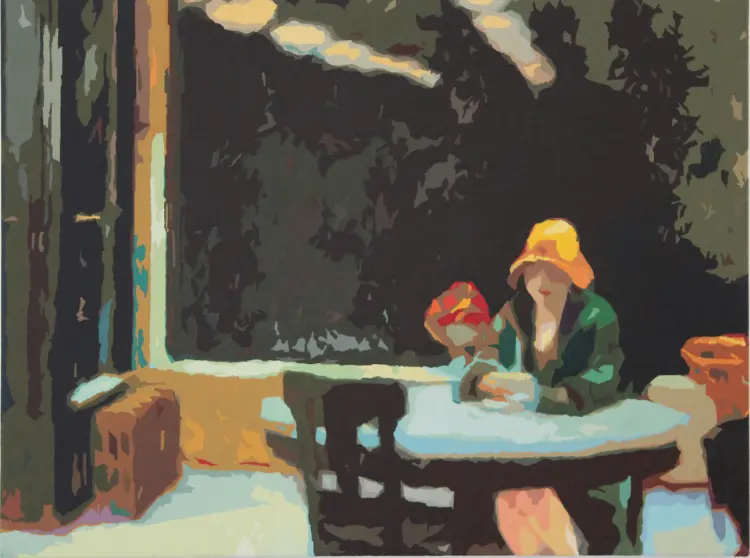
This work is anchored in Edward Hopper’s Automat (1927); however, the American master’s image operates here not as an homage or mere replication, but as a site of perceptual inquiry.
Hopper, renowned for architecting solitude as an atmospheric condition of modern life, provides a visual matrix already imbued with profound collective resonance. The exercise consists of dismantling this inherited weight to interrogate whether the mechanism of perceptual reconstruction remains viable when subjected to an image of divergent historical and cultural origins.
The composition preserves Hopper’s spatial architecture—the isolated female figure before the nocturnal window, the glass reflection, the vacant table—yet resolves it through discrete, hard-edged chromatic planes that deliberately strip away the original atmospheric gradation. This technical decision is not an exercise in stylization, but rather an attempt to lay bare the underlying mechanism through which solitude is visually engineered. The dark background, treated as a solid mass devoid of illusionistic depth, and the figure, articulated through modular fields of green, yellow, and warm tones, demonstrate that emotion does not inherently reside in the depicted scene, but rather in the perceptual syntax the artist imposes upon it.
The execution of this piece validates a core tenet of the Generative Gaze: its operational framework is entirely agnostic to the image’s origin or historical context. The methodology—select, fragment, recompose—can be applied with equal efficacy to an Edo-period Japanese photograph, a Teotihuacan mural, or an interwar American painting. Visual reality is not the exclusive property of a specific culture or epoch; it is continuously actualized each time a gaze structures it according to its own unique perceptual coordinates.
Ultimately, this work demonstrates that the creative process transcends mere stylistic or temporal contingencies. What Hopper engineered in 1927 through atmospheric haze and chiaroscuro is re-engineered here through flat color and stark contrast. This confirms that solitude is not an objective datum of the scene, but a perceptual construct that materializes anew every time it is observed with deliberate creative intent.
Size:
31.49" X 23.62"
Technique::
Oil on canvas.
Automat
This work is anchored in Edward Hopper’s Automat (1927); however, the American master’s image operates here not as an homage or mere replication, but as a site of perceptual inquiry.
Hopper, renowned for architecting solitude as an atmospheric condition of modern life, provides a visual matrix already imbued with profound collective resonance. The exercise consists of dismantling this inherited weight to interrogate whether the mechanism of perceptual reconstruction remains viable when subjected to an image of divergent historical and cultural origins.
The composition preserves Hopper’s spatial architecture—the isolated female figure before the nocturnal window, the glass reflection, the vacant table—yet resolves it through discrete, hard-edged chromatic planes that deliberately strip away the original atmospheric gradation. This technical decision is not an exercise in stylization, but rather an attempt to lay bare the underlying mechanism through which solitude is visually engineered. The dark background, treated as a solid mass devoid of illusionistic depth, and the figure, articulated through modular fields of green, yellow, and warm tones, demonstrate that emotion does not inherently reside in the depicted scene, but rather in the perceptual syntax the artist imposes upon it.
The execution of this piece validates a core tenet of the Generative Gaze: its operational framework is entirely agnostic to the image’s origin or historical context. The methodology—select, fragment, recompose—can be applied with equal efficacy to an Edo-period Japanese photograph, a Teotihuacan mural, or an interwar American painting. Visual reality is not the exclusive property of a specific culture or epoch; it is continuously actualized each time a gaze structures it according to its own unique perceptual coordinates.
Ultimately, this work demonstrates that the creative process transcends mere stylistic or temporal contingencies. What Hopper engineered in 1927 through atmospheric haze and chiaroscuro is re-engineered here through flat color and stark contrast. This confirms that solitude is not an objective datum of the scene, but a perceptual construct that materializes anew every time it is observed with deliberate creative intent.
Size:
31.49" X 23.62"
Technique::
Oil on canvas.