
The Apparition
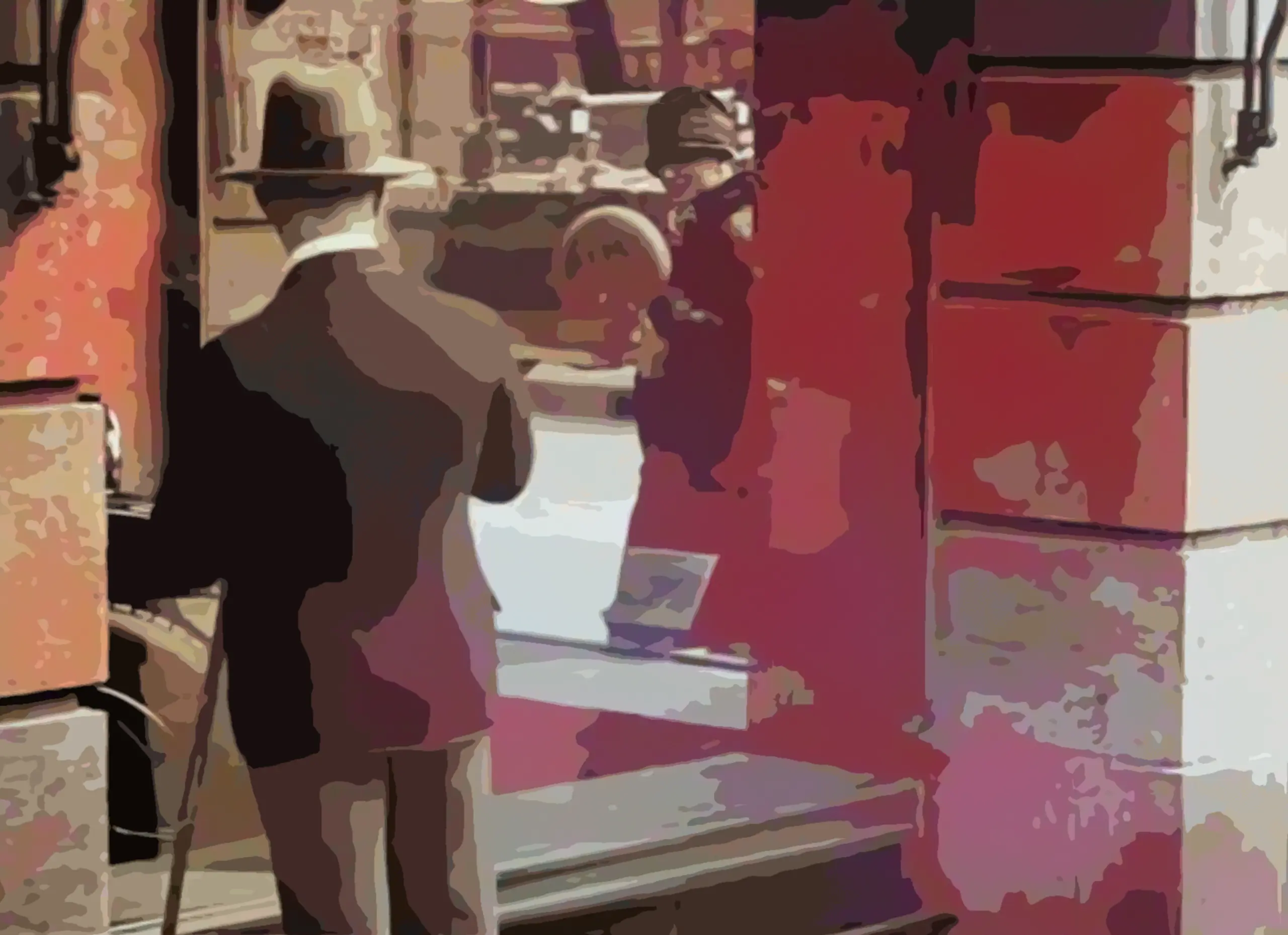
Anchored in a singular frame from Walter Ruttmann’s Berlin: Symphony of a Metropolis (1927), this work captures the precise instant the gazes of two strangers intersect through the glass of a storefront. The man, facing away, remains an indecipherable cipher; the woman responds with a warm, subtly sensual half-smile amidst the urban kinetic energy. Titled The Apparition, the piece materializes the ephemeral nature of this encounter: a shared perception that ruptures the mundane, only to dissolve in the very next instant.
The original frame originates from the twilight years of the Weimar Republic, an era of civil liberties poised on the precipice of the abyss. The resonance with contemporary Europe is deeply unsettling: the resurgence of fascist ideologies is fueled by the radical oversimplification of complex systemic issues. This false promise of order and unquestioning obedience offers existential relief to a populace exhausted by the perpetual flux generated by social media, mass communication, and propaganda. Delegating to the State the civic burden of critical reflection and the exercise of free will becomes dangerously seductive when daily existence demands a form of relentless, everyday heroism.
Within this context, the fleeting gaze acquires an unexpected, subversive political dimension. It operates as an act of perceptual resistance: two individuals who, standing at the edge of the abyss, recognize one another as conscious agents capable of actively constructing reality. While totalitarian ideologies impose a singular, reductive prism, this apparition asserts that reality multiplies exponentially within every unscripted encounter.
The glass functions as a semipermeable membrane between two worlds that, for a fraction of a second, become mutually permeable. On the other side lie no facile answers—only the open-ended inquiry of a smile as it fades. Within that fragility resides the courage to observe without blinking, steadfastly sustaining the profound complexity of the real.
Size:
Paper: 19.68" x 19.68"
Pictorial Mass: 14.56" x 10.43"
Technique:
Acrylic on paper..
This work resides within a private collection in Paris, France.
The Apparition
Anchored in a singular frame from Walter Ruttmann’s Berlin: Symphony of a Metropolis (1927), this work captures the precise instant the gazes of two strangers intersect through the glass of a storefront. The man, facing away, remains an indecipherable cipher; the woman responds with a warm, subtly sensual half-smile amidst the urban kinetic energy. Titled The Apparition, the piece materializes the ephemeral nature of this encounter: a shared perception that ruptures the mundane, only to dissolve in the very next instant.
The original frame originates from the twilight years of the Weimar Republic, an era of civil liberties poised on the precipice of the abyss. The resonance with contemporary Europe is deeply unsettling: the resurgence of fascist ideologies is fueled by the radical oversimplification of complex systemic issues. This false promise of order and unquestioning obedience offers existential relief to a populace exhausted by the perpetual flux generated by social media, mass communication, and propaganda. Delegating to the State the civic burden of critical reflection and the exercise of free will becomes dangerously seductive when daily existence demands a form of relentless, everyday heroism.
Within this context, the fleeting gaze acquires an unexpected, subversive political dimension. It operates as an act of perceptual resistance: two individuals who, standing at the edge of the abyss, recognize one another as conscious agents capable of actively constructing reality. While totalitarian ideologies impose a singular, reductive prism, this apparition asserts that reality multiplies exponentially within every unscripted encounter.
The glass functions as a semipermeable membrane between two worlds that, for a fraction of a second, become mutually permeable. On the other side lie no facile answers—only the open-ended inquiry of a smile as it fades. Within that fragility resides the courage to observe without blinking, steadfastly sustaining the profound complexity of the real.
Size:
Paper: 19.68" x 19.68"
Pictorial Mass: 14.56" x 10.43"
Technique:
Acrylic on paper..
This work resides within a private collection in Paris, France.