
A Singular Technique:
Dry brush in Oil
Oil on Paper: Quasi-Photographic Fidelity
The dry brush technique operates at the intersection of extraordinary subtlety and meticulous precision. Executed on paper, it yields works of near-photographic realism; translated to canvas, it achieves chromatic transitions of exceptional atmospheric depth
A Singular Opportunity for Cultural Institutions
This technique remains a largely uncharted frontier within contemporary art education, presenting a singular opportunity to offer your students a pioneering workshop unavailable through conventional academic channels. The dry brush method grants participants access to a distinct visual lexicon, profoundly expanding their technical repertoire and expressive vocabulary.
What Participants Will Master
• Master the precise manipulation of oil on paper to achieve quasi-photographic fidelity.
• Synthesize chromatic transitions and atmospheric nuances of extraordinary subtlety.
• Explore the boundless expressive potential of this largely uncharted technique.
• Cultivate a distinctive technical repertoire that positions them at the vanguard of the contemporary art landscape.
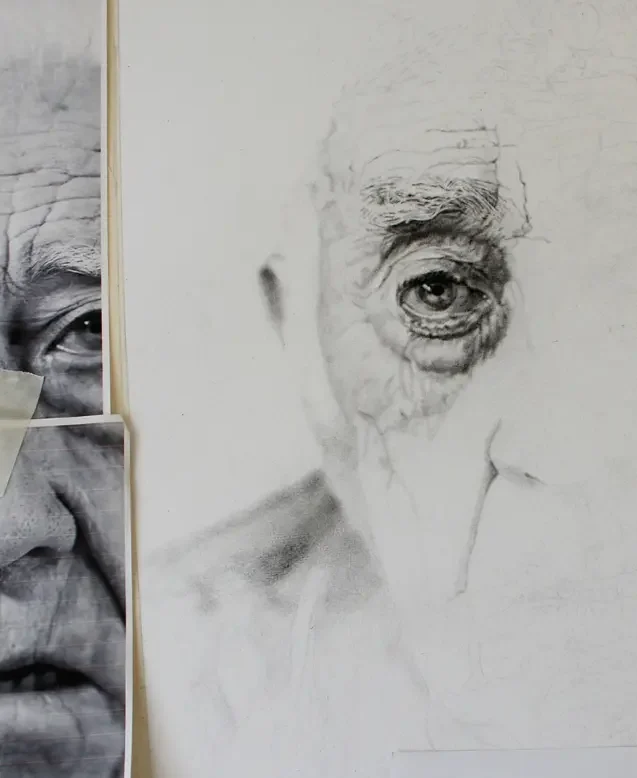
Instructed by: Luis Barquero Vernet
A Spanish visual artist, painter, and illustrator with a distinguished professional trajectory. His collaborative portfolio includes global entities such as Planeta De Agostini, the Bertelsmann Group, and LiveNation, alongside a diverse roster of international clients. He has mentored emerging artists in Mexico and exhibited his body of work across France, Spain, and Mexico. He is a specialist in the dry brush oil-on-paper technique—a methodology ideally suited for the precise construction of imagery and character design.
Duration: Minimum 10 hours, structured across 3 sessions
Level: All proficiency levels
Materials: Comprehensive list provided upon registration
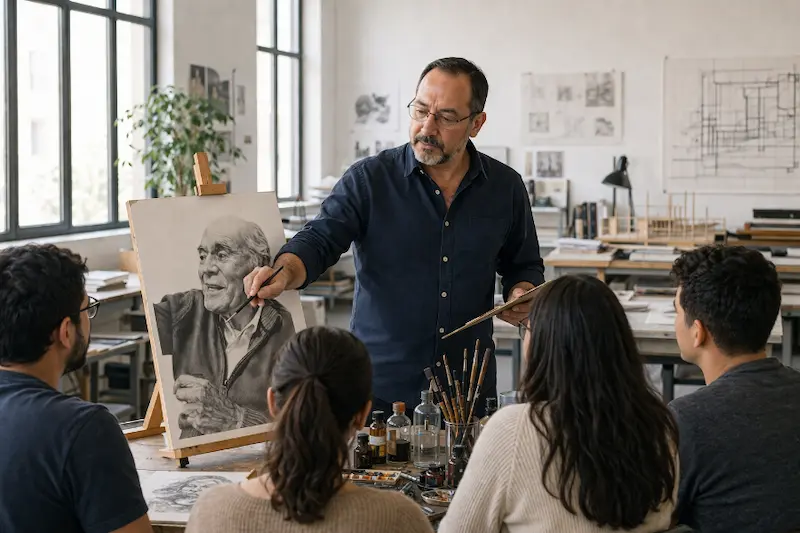
Process
Pedagogical Methodology
The curriculum is architected in three progressive phases, designed to organically cultivate the competencies required to master this largely uncharted technique.
PHASE I: Foundational Immersion
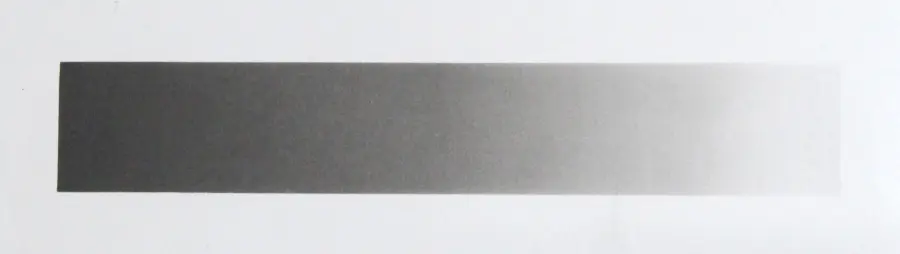
Exercise: The Rectangular Gradient
The initial engagement with the medium is anchored in a deceptively simple yet fundamental exercise: the execution of a rectangular gradient.
Core Objectives:
• Master brush calibration: Learning to precisely modulate the pigment load through repetitive, controlled wiping of the bristles.
• Unlock material versatility: Exploring the unique capacity of oil on paper for subtractive drawing, including the unexpected ability to erase and revise using a standard eraser.
• Navigate infinite tonal subtleties: Experimenting with the micro-variations in value and texture that this specific methodology permits.
• Develop material intuition: Internalizing the physical behavior and tactile response of the paper substrate.
This foundational exercise establishes the essential technical architecture upon which all subsequent creative explorations are built.
PHASE II: Applied Praxis
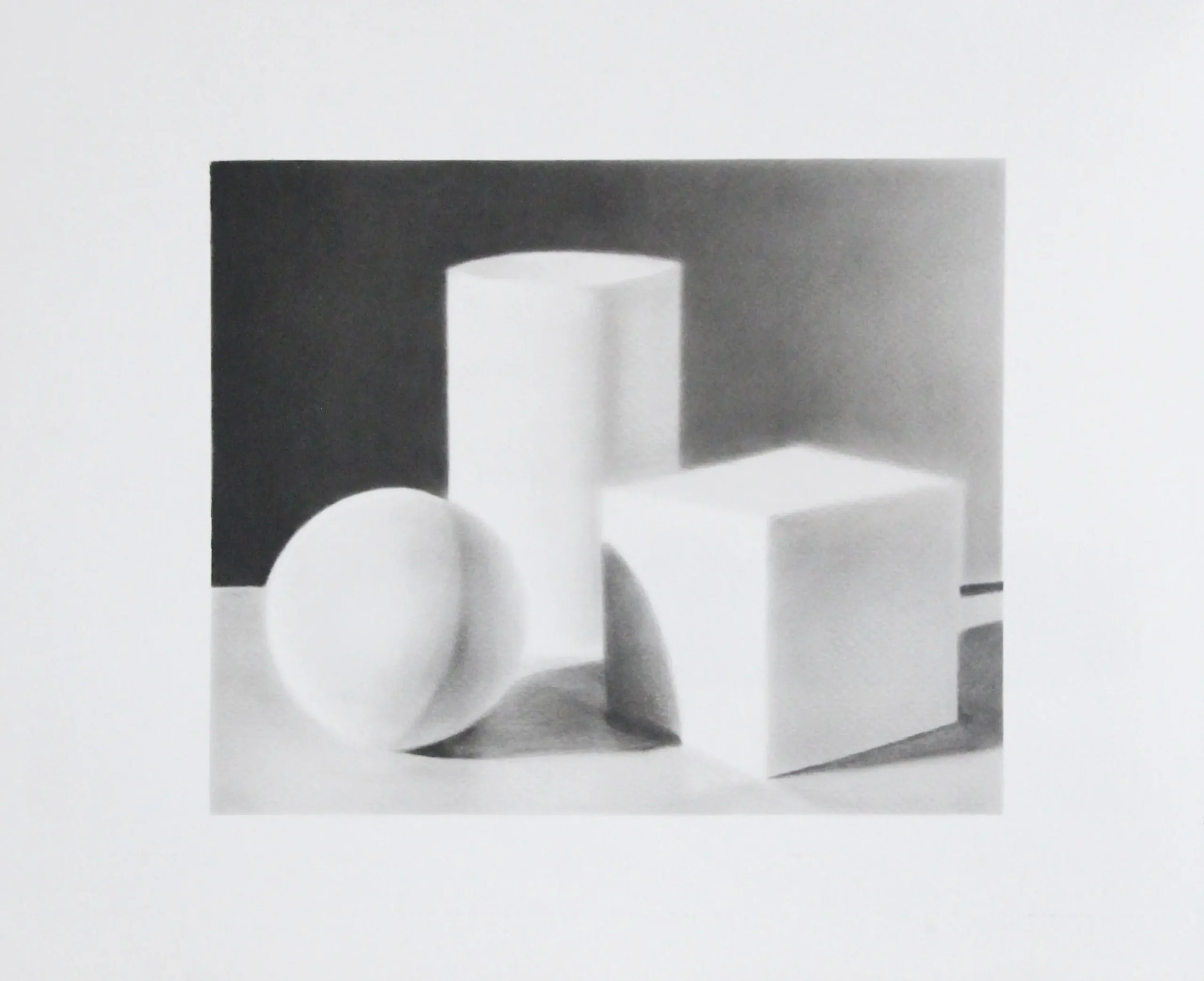
Exercise: Still Life of Primary Geometries
Upon mastering the foundational mechanics, the student translates their newly acquired skills into a still life composed of elementary geometric forms.
Core Objectives:
• Modulate across topographies: Master the technique's execution across diverse spatial zones and textural surfaces.
• Translate visual data: Cultivate acute observational acuity, translating visual phenomena into the distinct lexicon of the dry brush.
• Calibrate pigment deposition: Attain decisive confidence and absolute control in the precise application of the medium.
Pedagogical Methodology:
The workshop utilizes an asynchronous, self-paced progression. Upon successfully resolving a module, the student immediately advances to the next, independent of the cohort's collective pace. This framework ensures a highly individualized and optimized learning trajectory.
PHASE III: Capstone Project
Exercise: Complex Image of Independent Selection
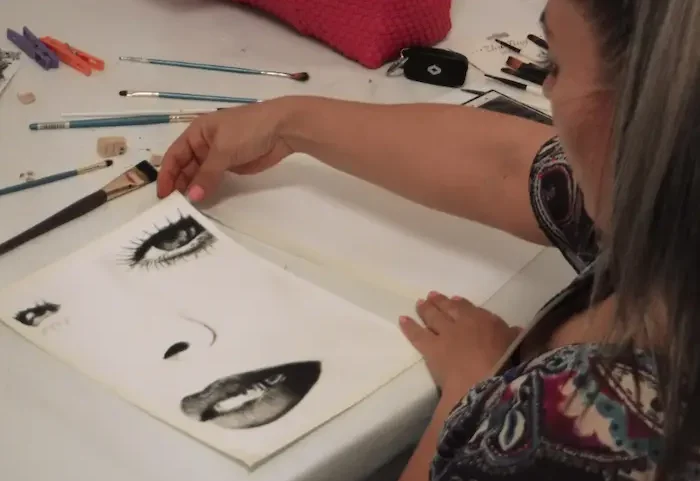
In this culminating stage, the student confronts the most rigorous exercise of the curriculum, synthesizing the full spectrum of methodologies acquired in the preceding phases.
Structural Parameters:
• Autonomous Subject Selection: While the workshop provides a baseline reference image, students are granted full autonomy to select and interpret a complex visual subject of their own choosing.
• Reference Iteration: Students are required to submit three letter-sized photocopies of their selected reference image to facilitate iterative spatial analysis and transfer.
• Navigating Material Complexity: This module demands the most extensive temporal investment, as it introduces the true mechanical complexities of the medium—navigating pigment saturation thresholds, executing precise subtractive scraping of the paper substrate, and managing physical material resistance.
• Predictive Problem-Solving: It serves as a critical laboratory for error correction, equipping the student with the analytical foresight to preemptively identify and avoid technical anomalies in future practice.
Recommended Temporal Allocation:
This final phase requires a temporal investment exceeding the sum of the preceding two phases. It is within this crucible of sustained, focused effort that true technical mastery and material intuition are permanently consolidated.
"ANIME & MANGA"
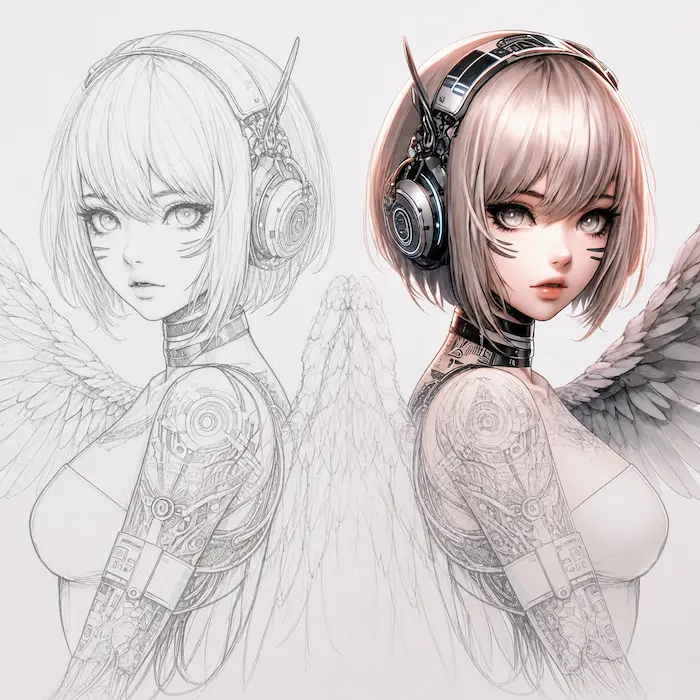
Dry Brush for Architects of Imagined Worlds
A singular methodology applied to anime, manga, and video game design.
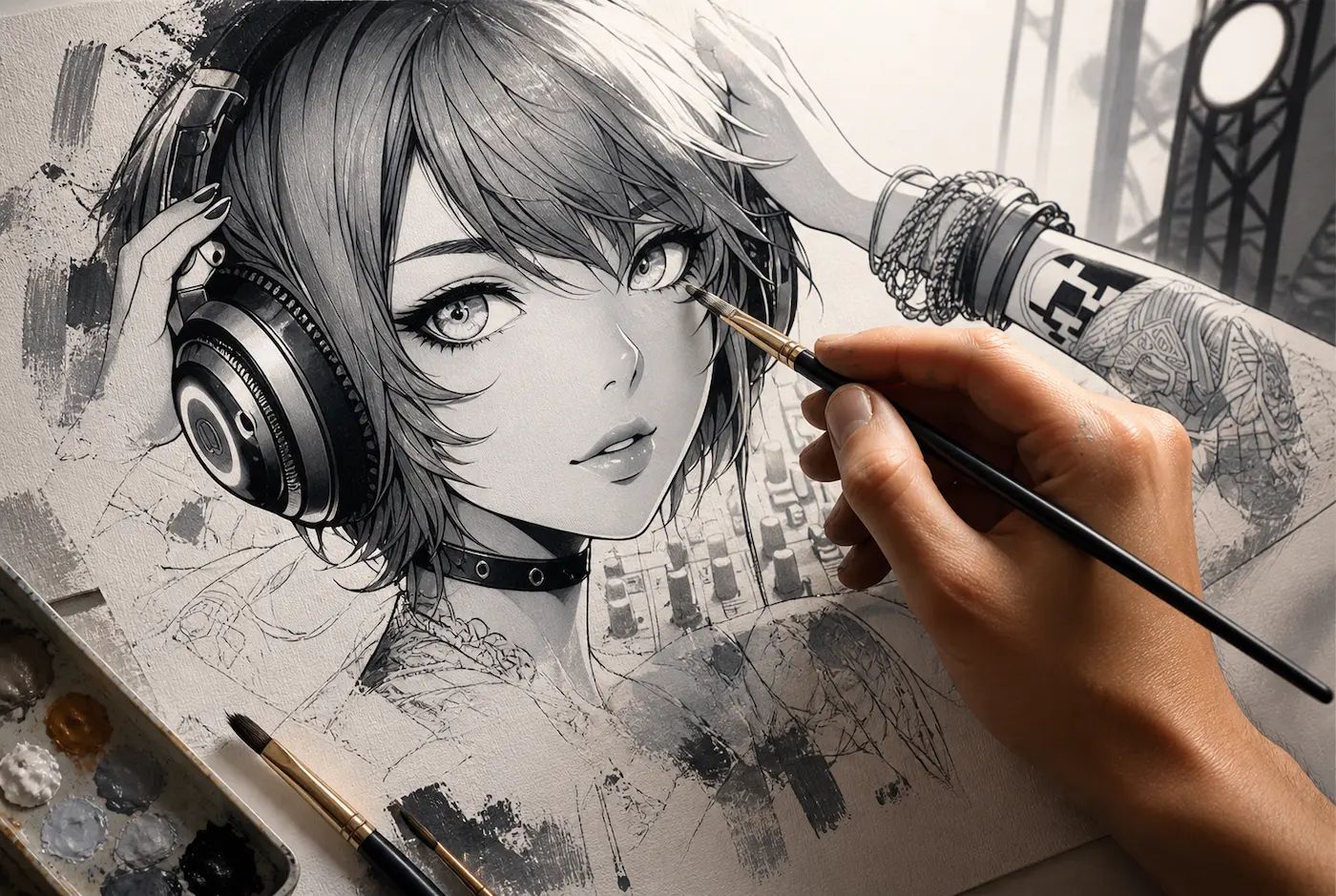
Does your institution foster a community of students passionate about anime, manga, or interactive entertainment? The dry brush technique transcends traditional academic painting. Its unparalleled capacity to render atmospheric depth, intricate textures, and distinct visual effects makes it an indispensable tool for illustrators, concept artists, and contemporary visual storytellers.
An Innovative Proposition
This modality adapts a largely uncharted technique to the visual vernacular that most resonates with emerging generations of creators. It offers your institution a pioneering workshop with no direct equivalent in the contemporary educational landscape.
Why Dry Brush for Anime and Manga?
The Strategic Advantage
1. Exceptional Atmospheric Rendering
• Generates fog, smoke, dust, and dynamic lighting effects with unparalleled organic fidelity.
• Achieves seamless gradients ideal for environmental backgrounds and immersive world-building.
• Imparts profound depth and volumetric weight to characters and spatial compositions.
2. Versatile Textural Topographies
• Renders diverse surfaces with precision, from metallic armatures to intricate fabrics and hair dynamics.
• Simulates authentic weathering, aging, and battle damage with striking realism.
• Bridges organic and mechanical elements, achieving hyper-realistic material fidelity.
3. Velocity and Operational Efficiency
• A methodology originally forged by artists demanding rapid execution without compromising structural integrity.
• Optimally suited for fast-paced concept art pipelines and interactive entertainment production.
• Facilitates rapid iterative prototyping while maintaining a premium standard of visual quality.
4. Professional Differentiation
• Equips students with a distinctive technical repertoire that commands attention in the competitive creative labor market.
• Infuses their portfolio with an irreplaceable, organic, and artisanal signature.
• Integrates seamlessly into hybrid workflows (easily scanned, digitized, and digitally refined).
Intended Audience Profile
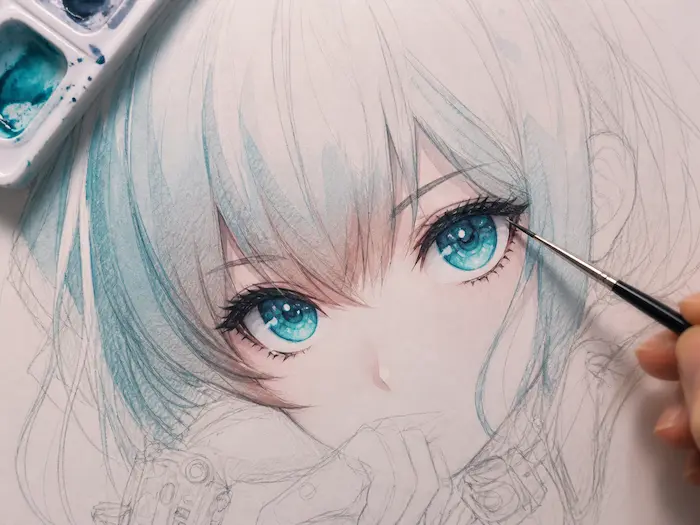
✓ Illustration and design students.
✓ Manga and sequential art creators.
✓ Concept artists for interactive entertainment.
✓ Character designers.
✓ Environment and background artists.
✓ Visual content creators.
✓ Fans del anime qu✓ Anime enthusiasts seeking to elevate their artistic practice to a professional tier.e quieren llevar su arte al siguiente nivel
No prior oil painting experience is required.
The curriculum is meticulously architected to guide the student from foundational principles to the creation of complete, polished illustrations utilizing this methodology.
Curriculum Learning Objectives
Specialized Methodologies for Anime & Manga:
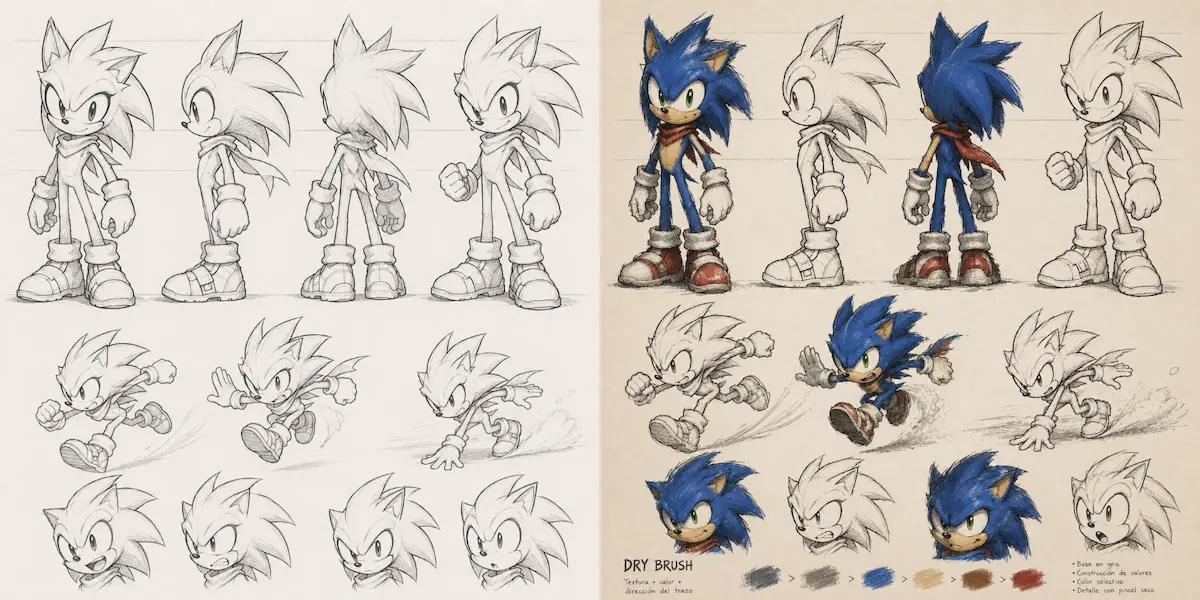
• Dynamic Hair Rendering: Engineering volumetric depth and realistic specular highlights within complex hair dynamics.
• Material Simulation: Executing precise texturing for metallic armatures, woven fabrics, and intricate accessories.
• Kinetic & Arcane Effects: Visualizing dynamic energy discharges, magical phenomena, and kinetic force.
• Atmospheric Perspective: Constructing deep, immersive environmental backgrounds through controlled atmospheric haze.
• Seamless Chromatic Transitions: Achieving flawless gradients for expansive skies and natural landscapes.
• Cinematic Chiaroscuro: Mastering dramatic lighting and shadow play to evoke narrative tension and cinematic depth.
Practical Applications & Industry Integration:
• Full-Body Character Illustration: Comprehensive rendering of complete, polished character designs.
• Environmental World-Building: Designing immersive scenarios and background plates.
• Asset & Prop Design: Crafting detailed in-game elements and interactive visual assets.
• Rapid Conceptualization: High-velocity concept art generation for iterative development pipelines.
• Key Art & Promotional Illustration: Producing high-impact cover art and marketing visuals.
Adaptive Methodology
While the traditional curriculum adheres to a progressive academic framework, the Anime-Manga modality immerses students immediately in the visual vernacular of the genre. From day one, the coursework is anchored in the specific references that ignite their creative passion:
Session I: Applied Fundamentals. Technical mastery is introduced through isolated, high-impact elements: dynamic hair rendering, ocular detail, and intricate wardrobe components.
Session II: Holistic Character Synthesis. The focus shifts to full-figure composition, emphasizing material simulation and the textural differentiation of complex designs.
Session III: Environmental World-Building. The curriculum culminates in dynamic spatial compositions, integrating atmospheric perspective and environmental storytelling.
Unrestricted Creative Autonomy
Diverging from rigid traditional constraints, this modality empowers students to channel their vision through original character designs, fan art, or bespoke video game concepts that genuinely inspire them.
Specialized Material Requirements
In addition to the foundational toolkit, students are advised to curate the following:
• A curated dossier of at least three (3) reference images (anime, manga, or video game assets) intended for replication.
• High-fidelity color prints of preferred characters or environmental scenes.
• A dedicated sketchbook for iterative planning and compositional mapping.
"I turn to the dry brush when my emotional engagement with a subject deepens sufficiently."
— Andrew Wyeth, Master of the Medium.
Offer your creative community a singular opportunity to master a methodology that will fundamentally redefine their artistic trajectory.
Dry brush in Oil
Oil on Paper: Quasi-Photographic Fidelity
The dry brush technique operates at the intersection of extraordinary subtlety and meticulous precision. Executed on paper, it yields works of near-photographic realism; translated to canvas, it achieves chromatic transitions of exceptional atmospheric depth
A Singular Opportunity for Cultural Institutions
This technique remains a largely uncharted frontier within contemporary art education, presenting a singular opportunity to offer your students a pioneering workshop unavailable through conventional academic channels. The dry brush method grants participants access to a distinct visual lexicon, profoundly expanding their technical repertoire and expressive vocabulary.
What Participants Will Master
• Master the precise manipulation of oil on paper to achieve quasi-photographic fidelity.
• Synthesize chromatic transitions and atmospheric nuances of extraordinary subtlety.
• Explore the boundless expressive potential of this largely uncharted technique.
• Cultivate a distinctive technical repertoire that positions them at the vanguard of the contemporary art landscape.
Instructed by: Luis Barquero Vernet
A Spanish visual artist, painter, and illustrator with a distinguished professional trajectory. His collaborative portfolio includes global entities such as Planeta De Agostini, the Bertelsmann Group, and LiveNation, alongside a diverse roster of international clients. He has mentored emerging artists in Mexico and exhibited his body of work across France, Spain, and Mexico. He is a specialist in the dry brush oil-on-paper technique—a methodology ideally suited for the precise construction of imagery and character design.
Duration: Minimum 10 hours, structured across 3 sessions
Level: All proficiency levels
Materials: Comprehensive list provided upon registration
Process
Pedagogical Methodology
The curriculum is architected in three progressive phases, designed to organically cultivate the competencies required to master this largely uncharted technique.
PHASE I: Foundational Immersion
Exercise: The Rectangular Gradient
The initial engagement with the medium is anchored in a deceptively simple yet fundamental exercise: the execution of a rectangular gradient.
Core Objectives:
• Master brush calibration: Learning to precisely modulate the pigment load through repetitive, controlled wiping of the bristles.
• Unlock material versatility: Exploring the unique capacity of oil on paper for subtractive drawing, including the unexpected ability to erase and revise using a standard eraser.
• Navigate infinite tonal subtleties: Experimenting with the micro-variations in value and texture that this specific methodology permits.
• Develop material intuition: Internalizing the physical behavior and tactile response of the paper substrate.
This foundational exercise establishes the essential technical architecture upon which all subsequent creative explorations are built.
PHASE II: Applied Praxis
Exercise: Still Life of Primary Geometries
Upon mastering the foundational mechanics, the student translates their newly acquired skills into a still life composed of elementary geometric forms.
Core Objectives:
• Modulate across topographies: Master the technique's execution across diverse spatial zones and textural surfaces.
• Translate visual data: Cultivate acute observational acuity, translating visual phenomena into the distinct lexicon of the dry brush.
• Calibrate pigment deposition: Attain decisive confidence and absolute control in the precise application of the medium.
Pedagogical Methodology:
The workshop utilizes an asynchronous, self-paced progression. Upon successfully resolving a module, the student immediately advances to the next, independent of the cohort's collective pace. This framework ensures a highly individualized and optimized learning trajectory.
PHASE III: Capstone Project
Exercise: Complex Image of Independent Selection
In this culminating stage, the student confronts the most rigorous exercise of the curriculum, synthesizing the full spectrum of methodologies acquired in the preceding phases.
Structural Parameters:
• Autonomous Subject Selection: While the workshop provides a baseline reference image, students are granted full autonomy to select and interpret a complex visual subject of their own choosing.
• Reference Iteration: Students are required to submit three letter-sized photocopies of their selected reference image to facilitate iterative spatial analysis and transfer.
• Navigating Material Complexity: This module demands the most extensive temporal investment, as it introduces the true mechanical complexities of the medium—navigating pigment saturation thresholds, executing precise subtractive scraping of the paper substrate, and managing physical material resistance.
• Predictive Problem-Solving: It serves as a critical laboratory for error correction, equipping the student with the analytical foresight to preemptively identify and avoid technical anomalies in future practice.
Recommended Temporal Allocation:
This final phase requires a temporal investment exceeding the sum of the preceding two phases. It is within this crucible of sustained, focused effort that true technical mastery and material intuition are permanently consolidated.
"ANIME & MANGA"
Dry Brush for Architects of Imagined Worlds
A singular methodology applied to anime, manga, and video game design.
Does your institution foster a community of students passionate about anime, manga, or interactive entertainment? The dry brush technique transcends traditional academic painting. Its unparalleled capacity to render atmospheric depth, intricate textures, and distinct visual effects makes it an indispensable tool for illustrators, concept artists, and contemporary visual storytellers.
An Innovative Proposition
This modality adapts a largely uncharted technique to the visual vernacular that most resonates with emerging generations of creators. It offers your institution a pioneering workshop with no direct equivalent in the contemporary educational landscape.
Why Dry Brush for Anime and Manga?
The Strategic Advantage
1. Exceptional Atmospheric Rendering
• Generates fog, smoke, dust, and dynamic lighting effects with unparalleled organic fidelity.
• Achieves seamless gradients ideal for environmental backgrounds and immersive world-building.
• Imparts profound depth and volumetric weight to characters and spatial compositions.
2. Versatile Textural Topographies
• Renders diverse surfaces with precision, from metallic armatures to intricate fabrics and hair dynamics.
• Simulates authentic weathering, aging, and battle damage with striking realism.
• Bridges organic and mechanical elements, achieving hyper-realistic material fidelity.
3. Velocity and Operational Efficiency
• A methodology originally forged by artists demanding rapid execution without compromising structural integrity.
• Optimally suited for fast-paced concept art pipelines and interactive entertainment production.
• Facilitates rapid iterative prototyping while maintaining a premium standard of visual quality.
4. Professional Differentiation
• Equips students with a distinctive technical repertoire that commands attention in the competitive creative labor market.
• Infuses their portfolio with an irreplaceable, organic, and artisanal signature.
• Integrates seamlessly into hybrid workflows (easily scanned, digitized, and digitally refined).
Intended Audience Profile
✓ Illustration and design students.
✓ Manga and sequential art creators.
✓ Concept artists for interactive entertainment.
✓ Character designers.
✓ Environment and background artists.
✓ Visual content creators.
✓ Fans del anime qu✓ Anime enthusiasts seeking to elevate their artistic practice to a professional tier.e quieren llevar su arte al siguiente nivel
No prior oil painting experience is required.
The curriculum is meticulously architected to guide the student from foundational principles to the creation of complete, polished illustrations utilizing this methodology.
Curriculum Learning Objectives
Specialized Methodologies for Anime & Manga:
• Dynamic Hair Rendering: Engineering volumetric depth and realistic specular highlights within complex hair dynamics.
• Material Simulation: Executing precise texturing for metallic armatures, woven fabrics, and intricate accessories.
• Kinetic & Arcane Effects: Visualizing dynamic energy discharges, magical phenomena, and kinetic force.
• Atmospheric Perspective: Constructing deep, immersive environmental backgrounds through controlled atmospheric haze.
• Seamless Chromatic Transitions: Achieving flawless gradients for expansive skies and natural landscapes.
• Cinematic Chiaroscuro: Mastering dramatic lighting and shadow play to evoke narrative tension and cinematic depth.
Practical Applications & Industry Integration:
• Full-Body Character Illustration: Comprehensive rendering of complete, polished character designs.
• Environmental World-Building: Designing immersive scenarios and background plates.
• Asset & Prop Design: Crafting detailed in-game elements and interactive visual assets.
• Rapid Conceptualization: High-velocity concept art generation for iterative development pipelines.
• Key Art & Promotional Illustration: Producing high-impact cover art and marketing visuals.
Adaptive Methodology
While the traditional curriculum adheres to a progressive academic framework, the Anime-Manga modality immerses students immediately in the visual vernacular of the genre. From day one, the coursework is anchored in the specific references that ignite their creative passion:
Session I: Applied Fundamentals. Technical mastery is introduced through isolated, high-impact elements: dynamic hair rendering, ocular detail, and intricate wardrobe components.
Session II: Holistic Character Synthesis. The focus shifts to full-figure composition, emphasizing material simulation and the textural differentiation of complex designs.
Session III: Environmental World-Building. The curriculum culminates in dynamic spatial compositions, integrating atmospheric perspective and environmental storytelling.
Unrestricted Creative Autonomy
Diverging from rigid traditional constraints, this modality empowers students to channel their vision through original character designs, fan art, or bespoke video game concepts that genuinely inspire them.
Specialized Material Requirements
In addition to the foundational toolkit, students are advised to curate the following:
• A curated dossier of at least three (3) reference images (anime, manga, or video game assets) intended for replication.
• High-fidelity color prints of preferred characters or environmental scenes.
• A dedicated sketchbook for iterative planning and compositional mapping.
"I turn to the dry brush when my emotional engagement with a subject deepens sufficiently."
— Andrew Wyeth, Master of the Medium.
Offer your creative community a singular opportunity to master a methodology that will fundamentally redefine their artistic trajectory.